REMOTE WORK & DIGITAL NOMAD
Lisbon vs. Porto for Remote Workers: Internet, Costs, and Coworking
I spent my first month in Portugal in Lisbon, my second in Porto, and the entire time my nomad friends back in Lisbon were asking when I was coming back, while
✓The Short Version of Each City✓Internet: The Thing That Actually✓Costs: Where Porto Pulls Ahead
Quick Answer
Lisbon is bigger, pricier, and better connected internationally, while Porto is cheaper, calmer, and increasingly well served by coworking spaces. Both have fast, reliable internet. Most remote workers pick Lisbon for the social scene and flight connections, and Porto for lower costs and a slower pace.
- Internet: both cities have widespread fiber; expect 200 to 500 Mbps in most apartments and coworking spaces, plenty for video calls.
- Costs: Porto runs about 20 to 30 percent cheaper than Lisbon for rent, eating out, and daily life.
- Coworking: Lisbon has the deeper bench of spaces and nomad events; Porto’s scene is smaller but growing fast and less crowded.
- Work from either without the login headaches: HomeIPVPN keeps your home-country accounts and work systems seeing your familiar home address from whichever city you choose.
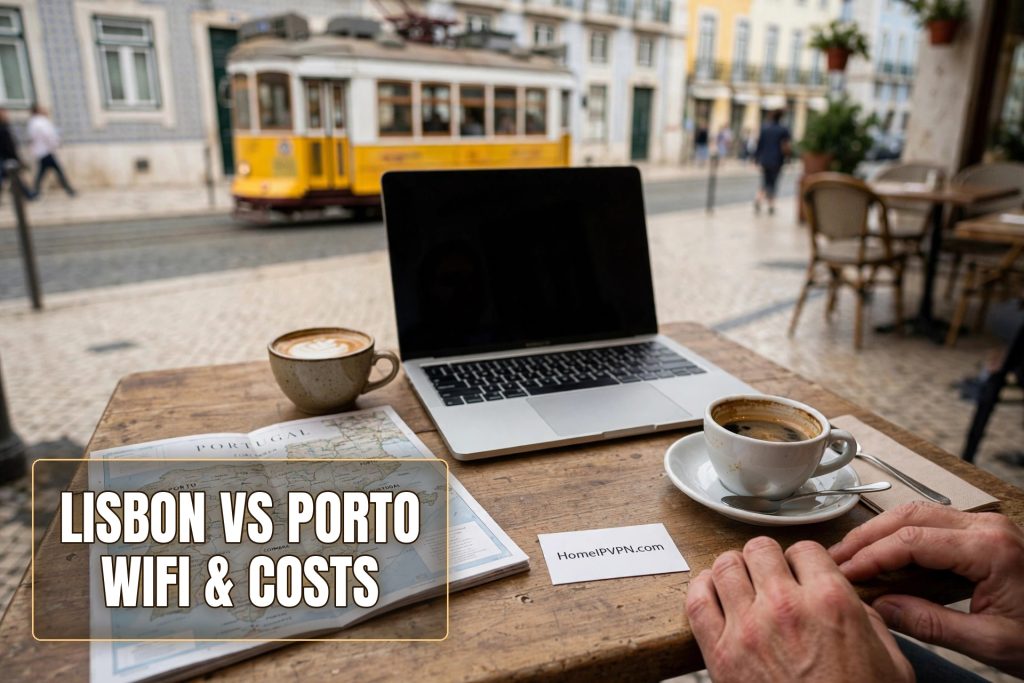
I spent my first month in Portugal in Lisbon, my second in Porto, and the entire time my nomad friends back in Lisbon were asking when I was coming back, while my new Porto friends were smugly insisting I would never leave. Both cities were right about themselves and wrong about the other. Three years later I still get asked which one a remote worker should pick, and the honest answer is that it depends on what kind of worker you are.
This is not a tourist comparison. You are not choosing where to spend a long weekend. You are choosing where your workdays happen: the internet you will rely on, the rent you will pay, the coworking desks you will sit at, the noise outside your window during calls. Here is the comparison I wish someone had given me before I signed my first lease.
The Short Version of Each City
Lisbon is Portugal’s capital and its biggest city, about half a million people in the city proper and nearly three million in the metro area. It feels like a capital: international airport with direct flights everywhere, neighborhoods full of nomads, a startup scene, embassies, and the kind of energy where something is always happening. It is also the most expensive city in Portugal, the most touristed, and the one where the hills will destroy your calves and your laptop bag’s shoulder strap in equal measure.
Porto is Portugal’s second city, about a quarter million in the center and 1.7 million in the metro area. It sits on the Douro river in the north, famous for port wine, dramatic bridges, and a historic center that looks like a film set. It feels more Portuguese and less international than Lisbon: fewer tourists per square meter, more locals in the cafes, a working city that happens to be beautiful rather than a beautiful city that happens to work. It is cheaper, rainier, and, according to its devoted fans, more authentic.
The rivalry between the two is real and mostly affectionate. Lisboetas think Porto is a charming village. Portuenses think Lisbon sold its soul to Airbnb. As a remote worker you get to enjoy the debate without picking a side permanently, because the train between them takes under three hours and costs less than a nice dinner.
Internet: The Thing That Actually Matters Most
Let us start with the question that decides everything else. Both cities have excellent internet by any reasonable standard. Portugal invested heavily in fiber, and it shows.
In Lisbon, fiber is essentially universal in the central neighborhoods. A typical apartment connection runs 200 to 500 Mbps down, with upload speeds that are genuinely good (often 100 Mbps or more), which is what keeps your video calls crisp. The coworking spaces, and there are dozens, all have business-grade connections with backup lines. I never once had an internet problem in Lisbon that was the city’s fault.
In Porto, the story is nearly identical. Fiber coverage is comprehensive in the areas nomads actually live: Cedofeita, Bonfim, Foz, the Ribeira. Speeds match Lisbon’s. The coworking spaces are fewer but every bit as well connected. If anything, Porto’s slightly smaller scale means less network congestion in the evenings, though in practice you would never notice the difference.
The honest verdict: internet is a tie. Do not choose between these cities based on connection speed, because you will not feel a difference. Choose based on everything below.
Costs: Where Porto Pulls Ahead
This is the biggest practical difference, and it is not close. Porto is meaningfully cheaper than Lisbon across the board, roughly 20 to 30 percent less for the things that make up a nomad’s monthly budget.
Rent is the headline. A decent one-bedroom apartment in a good Lisbon neighborhood (Alvalade, Graca, Arroios) runs 1,200 to 1,600 euros a month in the current market, and the nomad-popular areas near the center push higher. In Porto, a comparable one-bedroom in Cedofeita or Bonfim runs 800 to 1,100 euros. That is a few hundred euros a month staying in your pocket, every month, which over a year is a serious amount of money.
Daily life follows the same pattern. A coffee in Lisbon’s trendier areas: 1.50 to 2 euros. In Porto: often 1 euro or less, and nobody looks at you funny for paying it. Lunch menus (the beloved prato do dia): 12 to 15 euros in Lisbon, 9 to 12 in Porto. Coworking day passes and monthly memberships run 10 to 20 percent cheaper in Porto. Groceries are a wash, Portugal is affordable everywhere, but eating out and renting are where Porto’s advantage compounds.
The caveat: Lisbon’s higher costs come with higher earning-adjacent benefits. More networking, more clients passing through, more job-adjacent opportunities. If your income grows because you are in the room where things happen, Lisbon can pay for its own premium. But if your income is fixed and remote, Porto simply leaves more of it in your account.
Coworking and the Work Scene
Lisbon’s coworking scene is one of the best in Europe, full stop. Dozens of spaces across every neighborhood, from sleek corporate-feeling floors to converted warehouses with surfboards on the wall. The big names have multiple locations. There are nomad-specific events every week: meetups, skill shares, founder breakfasts, beach workdays in Cascais. If you want to be surrounded by other remote workers, Lisbon makes it effortless.
The tradeoff is that the popular spaces get crowded, especially September through November when the nomad season peaks. The best desks go early. Some spaces feel more like social clubs that happen to have WiFi than places to do deep work. And the constant churn of people arriving and leaving can make friendships feel oddly temporary, though that is the nomad condition everywhere.
Porto’s coworking scene is smaller but, in my experience, warmer. Fewer spaces, but the ones that exist tend to have stronger community because everyone knows everyone. You will see the same faces, which means actual friendships instead of endless first conversations. The spaces I worked from in Porto had better natural light, on average, and were noticeably quieter during focus hours. The events calendar is thinner, but what exists feels more genuine.
My take: if you feed off energy and networking, Lisbon. If you do deep focused work and want a calmer professional community, Porto. Neither city will leave you working alone in your apartment unless you want to.
Daily Life: Pace, Weather, and the Feel of the Place
Lisbon is sunnier, flatter in the center (do not believe the flatness, the hills are real), and more outward-facing. The light really is extraordinary, the kind that makes you understand why painters moved here. Winters are mild, summers are hot but tempered by the Atlantic breeze. The city sprawls, which means you pick a neighborhood and it becomes your village: your cafe, your grocery store, your running route along the river.
Porto is moodier in the best way. The north gets more rain, especially October through March, and the winters are properly chilly by Portuguese standards. But the rain makes everything green and dramatic, the river fog in the morning is beautiful, and when the sun comes out the whole city seems to exhale. Porto feels more compact and walkable; you can cross the meaningful parts of the city on foot in a way Lisbon’s sprawl does not allow.
Socially, Lisbon is easier to land in as a foreigner. English is everywhere, the nomad infrastructure (meetups, Facebook groups, WhatsApp communities) is mature, and you can build a social life in weeks. Porto takes a little longer but rewards the patience. The local culture is more present in daily life, which some nomads find refreshing after the international bubble feeling that parts of Lisbon can have.
Getting In and Out
Lisbon wins on connectivity, and for nomads who travel, this matters. Lisbon’s airport has direct flights to what feels like everywhere: North America, all of Europe, Brazil, parts of Africa and the Middle East. If your lifestyle involves monthly trips, or clients who expect you to show up in person occasionally, Lisbon’s flight map is a genuine work tool.
Porto’s airport is smaller but far from isolated. It has excellent connections across Europe, especially to the UK, France, Germany, and Spain, plus growing long-haul options. For most European travel it is completely fine. You only feel the difference when you need to get to the Americas or Asia, where you will usually connect through Lisbon or another hub.
Within Portugal, the train between the two cities is fast, comfortable, and cheap enough to make weekend trips casual. Plenty of nomads base in one and visit the other regularly. You are not choosing a prison; you are choosing a home base.
So Which One Should You Pick?
Pick Lisbon if: your work benefits from networking and being around other remote professionals, you travel internationally often, you want the biggest social scene and the most coworking options, you love sun and big-city energy, and the higher rent fits your budget without stress.
Pick Porto if: your rent budget matters, you do focused work and prefer calmer spaces, you like the idea of a more local-feeling city, you do not mind rain, and you want your money to go further while your internet stays just as fast.
And here is the secret the rivalry obscures: you cannot really get this wrong. Both cities have the fiber, the coworking, the cafes, the community, and the quality of life that make Portugal one of the best remote-work bases in the world. The nomads I know who picked “wrong” just moved after a few months, and the train ride between the two is lovely.
One Less Thing to Think About
Whichever city you choose, one practical detail follows you: your bank, your clients’ systems, and your work tools will see you logging in from Portugal every day. For most people that is a non-event. But if you would rather your digital life looked exactly like it did before the move, HomeIPVPN keeps your connection coming from your own home address, whether your apartment overlooks the Tagus or the Douro.
It is one of those things you set up once, before you fly, and then forget about while you argue with your friends about which city is better.
Making the Move Real
The pattern underneath this whole comparison is simple: moving your work life to another country means your digital footprint moves too, and the services back home do not always adjust gracefully. Appearing at home while living abroad is the problem HomeIPVPN was built to solve, in plain terms, your logins come from your own home address no matter which Portuguese city you call home.
If you would rather have someone set it up and verify it works, the Pre-Travel Audit & Advisory session is 1 hour, costs $79, and that fee comes straight off the $279 Secure Home IP VPN System session if you go ahead.
Lisbon or Porto, you have already made the good decision. The rest is just details, and very pleasant ones.