REMOTE WORK & DIGITAL NOMAD
How to Handle US Banking While Living in Thailand
Picture this. You have been in Thailand for three months. Life is good. The coffee is cheap, the apartment has a pool, your work is getting done. Then one…
✓Rule one: the bank needs a US✓Rule two: fix your phone number✓Rule three: act like an active
Quick Answer
You can absolutely keep US bank accounts while living in Thailand, but it takes deliberate setup: a US address on file, a way to receive verification codes, and login habits that do not scream “foreign country” to the fraud system. The people who run into trouble are the ones who change nothing and hope for the best.
- Keep a US address: Banks require a US residential address. A mail forwarding service with a real street address works; a Thai address on file can trigger account reviews or closure.
- Solve the 2FA problem early: Move bank verification to an authenticator app or a VoIP number you control before you leave. Codes sent to an old SIM you cannot access will lock you out at the worst moment.
- Stay active and reachable: Log in regularly, keep some direct deposits or autopays running, and answer any verification mail your forwarding service receives.
- Look like you are home: Logging in from a Thai IP can trigger fraud flags, so route banking sessions through your home connection with HomeIPVPN to keep everything looking normal.
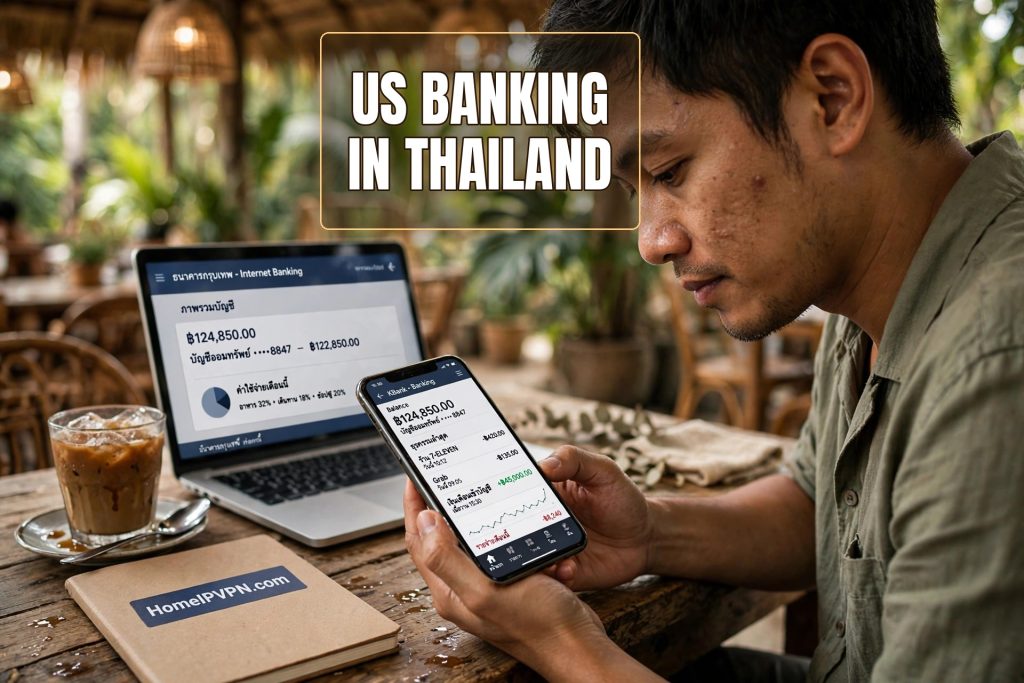
Picture this. You have been in Thailand for three months. Life is good. The coffee is cheap, the apartment has a pool, your work is getting done. Then one Tuesday morning you try to log in to your bank and see those words: “We need to verify your identity.” The code goes to a phone number you have not used since you landed. The backup option is a security question about an address you moved out of two years ago. And just like that, your money is behind a glass wall you cannot tap through.
This happens to Americans in Thailand constantly. Not because banks are evil, but because the whole US banking system was built on an assumption you have quietly broken: that you live in the United States. Once you understand what the system expects, keeping your accounts running smoothly from Bangkok or Chiang Mai or a beach in Krabi is very manageable. Here is the whole playbook, in plain English.
Rule one: the bank needs a US address, always
Almost every US bank requires a residential address in the United States on your account. This is not a suggestion. It is tied to identity verification rules and, for some banks, to their charter. If you change your address to a place in Thailand, you can trigger anything from a polite request for US documentation to a full account review.
The standard solution is a mail forwarding service that gives you a real US street address, not a PO box. Companies like Traveling Mailbox, Anytime Mailbox, or US Global Mail scan your mail and let you read it online. You set that address as your address of record with the bank. It costs roughly 10 to 25 dollars a month, which is cheap insurance for keeping your accounts open.
One thing to be careful about: some banks have started rejecting known forwarding addresses. It does not happen often, but it happens. The workaround most nomads use is to keep a family member’s address or a trusted friend’s address as the mailing address, with the forwarding service as a backup. Whatever you do, do not just leave your old apartment’s address on file if someone else lives there now. Returned mail is one of the fastest ways to get flagged.
Rule two: fix your phone number before you leave
This is the trap that catches the most people. Your bank sends verification codes by text to your US number. You land in Thailand, you swap in a Thai SIM, and your US number sits in a drawer. Then the bank needs to verify you, the code goes into the void, and you are locked out.
Fix this before you fly. The best options, in order of reliability:
First, switch your bank’s two-factor authentication to an authenticator app like Google Authenticator or Authy if the bank supports it. An app does not care what country you are in or what SIM is in your phone. Second, port your US number to a VoIP service like Google Voice. It keeps receiving texts over WiFi anywhere in the world, and it costs nothing. Third, keep your US carrier plan on the cheapest tier and enable WiFi calling, so texts still arrive.
What does not work reliably: assuming the bank will call your Thai number, assuming email verification will be offered as a fallback, or assuming you will “deal with it later.” Later is always a Tuesday morning with a deadline.
Rule three: act like an active customer
Banks close accounts they consider dormant or risky. An account that sits untouched for a year, owned by someone with no US address activity, looks like exactly the kind of account compliance departments worry about. The fix is simple: use the account.
Keep a direct deposit flowing in, even a small one. Keep autopay running on a couple of US bills. Log in from a consistent setup every week or two. If your mail forwarding service gets a letter from the bank asking you to confirm something, respond the same day. Banks mostly close accounts through slow neglect, not sudden decisions. A little regular activity keeps you firmly in the “normal customer” bucket.
The timezone problem nobody warns you about
Thailand is 11 to 14 hours ahead of the US, depending on the season and the coast. That means when your bank’s fraud department calls at 2pm Eastern to verify a transaction, it is 2am in Bangkok. Miss that call and the verification window can close.
Set up a system. Keep your US number reachable through VoIP with notifications on. Check your bank app every morning with your coffee, before the US business day starts, so you catch alerts early. And if you know a big transfer or unusual purchase is coming, call the bank first during US business hours, which means staying up late or getting up early your time, and tell them it is you. A two minute heads-up prevents a two week headache.
ATMs and cards: the daily mechanics
Daily banking in Thailand mostly means ATMs and card payments. Thai ATMs charge a 220 baht fee per foreign withdrawal, roughly six to seven dollars, on top of whatever your bank charges. The workaround is to withdraw larger amounts less often, and to use a bank or account that reimburses foreign ATM fees. Charles Schwab’s checking account is the classic nomad pick for exactly this reason.
For card payments, always pay in Thai baht when the terminal asks, and decline the “convenient” conversion to dollars. That conversion, called dynamic currency conversion, hides a markup of three to five percent. Your bank’s own exchange rate is almost always better. Also, carry a backup card from a different bank. Cards get eaten by ATMs, declined by confused fraud systems, and demagnetized at the worst times. Two cards from two banks is the minimum.
Wire transfers and moving bigger money
When you need to move real money, like paying a landlord three months of rent or receiving a big client payment, do not use your bank’s wire service. The fees are high and the exchange rates are padded. Services like Wise move money between US and Thai accounts at close to the real exchange rate, for a fraction of the cost.
One caution: Wise is not a bank, and accounts do get reviewed or frozen when activity looks unusual. Keep your verification documents current, do not route other people’s money through your account, and keep a second transfer option ready. The same principle applies everywhere in this guide: never have exactly one way to access your money.
The login location problem
Here is the issue that ties all of this together. Every time you log in to your US bank from a Thai IP address, you are telling the fraud system that you are in Thailand. One login is fine. A pattern of logins from Bangkok, with occasional jumps to a VPN server in Singapore because the cafe WiFi was slow, starts to look like account takeover behavior. That is when the verification challenges multiply.
The cleanest fix is to make your banking logins look like they come from home. A home IP VPN routes your connection through your own home internet back in the US, so the bank sees the same residential IP address it has always seen from you. No new country, no data center IP, no questions. HomeIPVPN sets this up as a small travel router you carry with you, so every device you own appears to be sitting in your living room back home.
This one change removes a whole category of problems: fewer verification texts, fewer frozen logins, fewer panicked calls at 2am Bangkok time. It does not replace the address and phone setup above, but it makes everything else work more smoothly.
What to do before your flight: the checklist
If you take nothing else from this guide, do these things in the two weeks before you leave. Set up a US mail forwarding address and update it with every bank. Move two-factor authentication to an authenticator app or port your number to VoIP. Tell each bank you will be traveling, even if the travel notice only lasts 90 days, it covers the risky transition period. Set up a home IP connection for banking logins. And stash a backup card somewhere separate from your wallet.
None of this is hard. It is just the kind of boring admin work that feels skippable until the morning it is not. The Americans who bank smoothly from Thailand are not lucky. They did the paperwork.
The thread running through all of this is location. Banks trust customers who look like they are home, and everything gets harder the moment you look like you are somewhere else. That is the exact problem HomeIPVPN was built to solve: keeping your connection anchored at home no matter where you actually are. If you would rather have someone set it up and verify it works before you fly, the Pre-Travel Audit & Advisory session is 1 hour, costs $79, and that fee comes straight off the $279 Secure Home IP VPN System session if you go ahead.
Do the boring setup now, and Thailand gets to be about the food and the beaches and the work getting done. That is the whole point of going.