REMOTE WORK & DIGITAL NOMAD
Colombia Digital Nomad Visa: Requirements in Plain English
The visa website loaded in Spanish, the checklist was eleven items long, and item seven was a document I had never heard of. I sat in a coworking space in El…
✓What the visa actually is✓The income requirement, kept simple✓The documents you will need
Quick Answer
Colombia’s digital nomad visa lets remote workers earning foreign income live in the country legally. It has a lower income threshold than many similar programs, requires proof of remote income plus standard documents, and applications take time, so start early.
- Who it is for: remote workers and freelancers whose income comes from outside Colombia, with no Colombian employer needed
- Income bar: the threshold is modest compared to other regional programs, typically based on recent bank statements or employer letters
- Timing: expect bureaucracy to take longer than planned, so begin the process well before your planned move
- Banking tip: while you wait, make sure your home bank accounts stay reachable from abroad, which is where HomeIPVPN helps
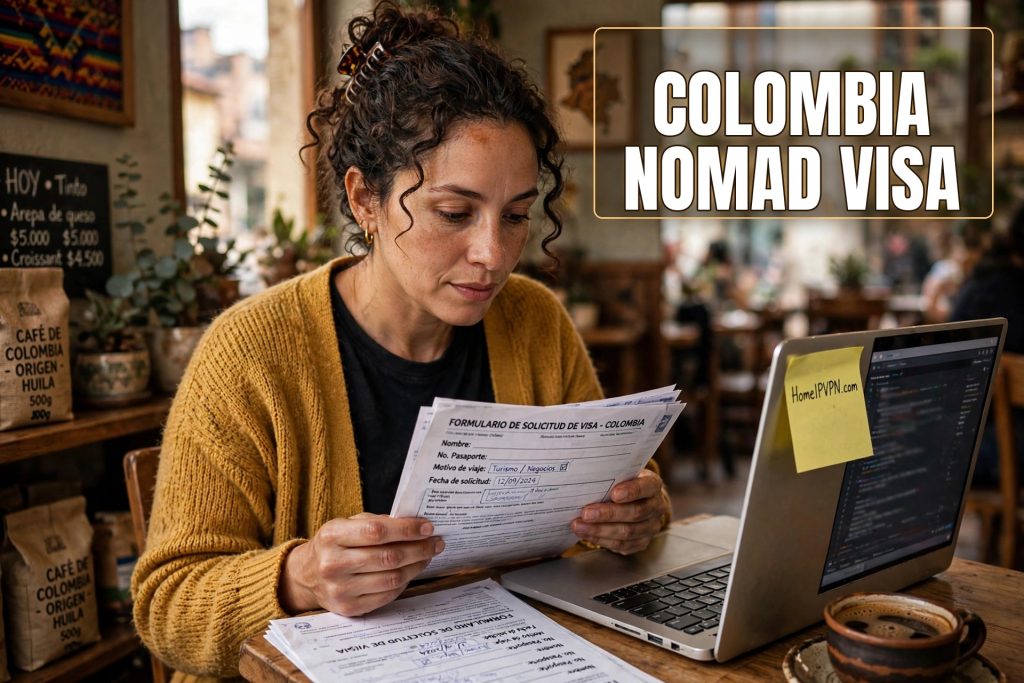
The visa website loaded in Spanish, the checklist was eleven items long, and item seven was a document I had never heard of. I sat in a coworking space in El Poblado, coffee going cold, trying to figure out whether “antecedentes judiciales” meant what I thought it meant. (It did. Background check.)
That was my first afternoon trying to understand the Colombia digital nomad visa. Three months later I had the visa in my passport and a much better understanding of how the whole thing actually works. This post is the guide I wish someone had handed me that afternoon: the requirements in plain English, no legal jargon, no invented details, just what you need to know.
One important note before we start. Visa rules change. Governments update thresholds, documents, and procedures, sometimes without much notice. Everything here reflects the widely reported basics of the program, but treat this as your starting map, not the final word. Before you apply, confirm the current requirements with the Colombian consulate or a local immigration advisor. I am a nomad, not a lawyer.
What the visa actually is
The digital nomad visa is Colombia’s way of saying: we like remote workers, come stay a while. It is a visa category for people who work remotely for employers or clients located outside Colombia. Your income has to come from abroad. You are not taking a local job, you are not competing with Colombian workers, you are just living there and spending your foreign-earned money in the local economy. That is the deal, and it is a good one for both sides.
You do not need a Colombian employer. You do not need to incorporate a company. You do not need to invest anything. You need to show that you are a real remote worker with real foreign income, and that you can support yourself while you are there.
This is different from arriving as a tourist and working quietly from a cafe. Tourists are not supposed to work, even remotely, and while plenty of people do it, it leaves you without legal status as a worker. The nomad visa gives you a clean, legal footing: a document that says you are allowed to be there doing exactly what you are doing.
The income requirement, kept simple
Every nomad visa has an income threshold, and Colombia’s is one of the reasons the program is popular. It is set at a level that a typical remote worker can reach, not just senior executives at big tech companies. Reports from immigration advisors and nomad communities consistently describe it as modest compared to similar programs in Europe or other parts of Latin America.
What counts as income? Generally, your salary or freelance earnings from outside Colombia. The key phrase is “outside Colombia.” Income from Colombian clients or employers is a different category with different rules. If you are a freelancer with clients in several countries, what matters is that the money is not Colombian.
How do you prove it? This is where the paperwork comes in. The standard proof is recent bank statements showing regular incoming payments, or a letter from your employer confirming your role, salary, and that you work remotely. Freelancers typically show contracts or invoices plus bank statements showing the payments landing. The general principle: show a paper trail that a reasonable official would look at and say, yes, this person earns money remotely from abroad.
The exact threshold can change, and it is often expressed in terms of local minimum wages, which themselves get updated. So rather than quoting a number that might be stale by the time you read this, here is the durable advice: check the current figure with the consulate or an advisor, and if you are comfortably above what you find, you are fine. Most full-time remote workers clear it without drama.
The documents you will need
Visa applications are document hunts. Here is the typical list, in the plainest terms I can manage.
Your passport, valid well beyond your planned stay. This is universal and non-negotiable. If your passport expires within a year, renew it first and save yourself a world of pain.
Proof of income, as described above: bank statements, employer letters, contracts, invoices. Bring more than you think you need. Officials like to see consistency over several months, not just one good pay stub.
A background check from your home country or your country of recent residence. This is the “antecedentes” document that confused me that first afternoon. Every country issues these differently: an FBI check in the US, a DBS check in the UK, and so on. They can take weeks to arrive, so request yours early. This is the single most common reason applications stall.
Proof of health insurance that covers you in Colombia. Travel medical insurance usually works. Make sure the policy document clearly states the coverage period and that it applies in Colombia, because vague policies get questioned.
A passport-style photo, the application form itself (usually online now), and the application fee. Fees change, so check the current amount on the official site.
Some applicants also get asked for proof of accommodation or a return ticket. These are not always required for the nomad category specifically, but having a booking for your first weeks and a flexible return ticket smooths the conversation.
Where and how to apply
There are two main paths, and nomads use both.
Path one: apply from outside Colombia at a Colombian consulate. You gather your documents, submit them through the consulate’s process, and enter Colombia with the visa already approved. This is the cleaner path if you like having everything settled before you fly. The downside is that consulate processes vary by country, and some consulates are faster and more helpful than others.
Path two: enter Colombia as a tourist first, settle in, and apply from inside the country with the help of a local immigration advisor. Many nomads choose this route because it lets you start living your life while the paperwork moves. The downside is living with uncertainty while you wait, and you need to make sure your tourist stay covers the processing time.
Either way, consider hiring help. A local immigration advisor in Medellin or Bogota typically charges a reasonable fee and knows exactly which office wants which document in which order. The nomads I know who tried to do it entirely alone mostly succeeded, but they all said the same thing: the advisor would have saved them weeks. If your Spanish is limited, this is not the place to practice it. Get someone who does this for a living.
Timing is the thing nobody budgets for properly. Between gathering documents, waiting for the background check, submitting, and waiting for approval, the whole process commonly takes a couple of months from start to finish. Sometimes faster, sometimes slower. Start earlier than you think you need to.
The tax question everyone asks
I am not a tax advisor, and this is not tax advice. But here is the plain-English shape of the issue, because every nomad asks about it.
Staying in a country long enough can make you a tax resident there, and tax residency can create filing obligations. Colombia has its own rules about when someone becomes a tax resident, generally tied to how many days you spend in the country. This is separate from the visa: the visa lets you stay, the tax rules decide whether you owe anything.
The practical advice is simple and boring: talk to a tax professional who understands both your home country’s rules and Colombia’s before you commit to a long stay. Many nomads structure their year across countries partly for this reason. Do not rely on forum posts for tax decisions. Forums are great for restaurant tips and terrible for tax planning.
What life looks like once you have it
Here is the part that makes the paperwork worth it. With the visa sorted, Colombia becomes one of the best-value nomad bases in the Americas.
Medellin gets the most attention, and for good reason: eternal spring weather, fiber internet with travelers reporting 100 to 300 Mbps in modern buildings, and a nomad community big enough that you will find your people within a week. Monthly costs for a comfortable life typically land between $1,200 and $1,800, which is hard to beat for the quality of life on offer.
Bogota is the capital option: bigger, cooler (literally, it sits at 2,600 meters), more cosmopolitan, with a serious business and tech scene. The weather is grayer and the pace is faster, but some nomads prefer its big-city energy. Internet is solid, costs are similar to Medellin, and the cultural life is enormous.
Cartagena is the Caribbean dream: colonial streets, sea breezes, and some of the most beautiful scenery in the country. It is hotter, more touristy, and pricier than the inland cities, and the internet can be less consistent outside the main tourist zones. Lovely for a month, harder as a full-time base for heavy video-call schedules.
Wherever you land, the rhythm of nomad life in Colombia is similar: mornings for deep work before the US East Coast wakes up, afternoons that stretch into long lunches, and evenings in plazas that stay alive late. The time zones line up beautifully with North American work hours, which is one of the quiet superpowers of basing yourself in Colombia.
The one problem the visa does not solve
Here is something the visa guides never mention. Your visa lets you live in Colombia. It does not convince your bank that you still live at home.
Banks, brokerages, and payment platforms watch where you log in from. When your internet location moves from your home country to Colombia, their security systems notice. Sometimes that means a verification code. Sometimes it means a locked account and a phone call to a fraud department that keeps your home country’s business hours, which is the middle of your night in Medellin.
This gets worse the longer you stay. A two-week trip barely registers. Six months in Colombia with a nomad visa, logging in from a Colombian IP address every single day, looks to an automated system like you moved permanently or like someone took over your account. The longer your stay, the more you need your connection to look normal.
The straightforward fix is to keep a home IP address: an internet connection that looks like it is coming from your home country no matter where you actually are. HomeIPVPN does this with a small device installed at your home (or another trusted spot) before you travel. Your traffic routes through it, so your bank sees the same home IP it has always seen, and the security flags never fire.
It is worth setting this up before you leave, because the device has to be at home before you fly. Think of it as part of the same preparation as the visa paperwork: one protects your legal status, the other protects your access to your own money. A HomeIPVPN setup means the account lockouts that plague long-stay nomads simply do not happen to you.
So here is the real talk on the whole visa project. The root cause of most nomad admin pain is not any single document, it is the mismatch between a life lived across borders and systems built for people who stay put. Banks, tax offices, and account security all assume you live in one place. The visa fixes the legal side of that mismatch in Colombia. The connection side, making your internet location match the life your accounts expect, is exactly the problem HomeIPVPN was built to solve: your traffic looks like it comes from home, so your accounts stop treating you like a stranger.
If you would rather have someone set it up and verify it works, the Pre-Travel Audit & Advisory session is 1 hour, costs $79, and that fee comes straight off the $279 Secure Home IP VPN System session if you go ahead.
Start the background check now, hire the advisor, and give yourself more time than you think you need. Colombia is worth the paperwork. See you in the eternal spring.