REMOTE WORK & DIGITAL NOMAD
Tokyo Cafes and Coworking: Where Remote Workers Actually Work
It is 9:40 on a Wednesday morning in Shimokitazawa, and the cafe you found yesterday is already half full. The barista remembers your order, which feels like a
✓First, understand the two✓Tokyo cafes: where to actually work✓The etiquette that keeps you
Quick Answer
Tokyo has excellent options for remote work, but cafes and coworking spaces serve different needs: cafes are for focused solo work with great coffee, coworking spaces are for calls, long days, and community. Japanese etiquette matters in both, especially around noise, seating time, and phone calls. Learn the unwritten rules and Tokyo becomes one of the best work cities in the world.
- Cafes: Great for writing and deep work; buy regularly, keep calls off speaker, and do not camp tables at rush hour.
- Coworking: The right choice for video calls, full workdays, and meeting other remote workers; day passes are widely available.
- Etiquette: Quiet voices, no speakerphone, clean up after yourself, and respect time limits during busy periods.
- Staying connected: Whether you work from a Shibuya coworking desk or a Kyoto cafe, a steady home IP from HomeIPVPN keeps your bank and work logins drama free.
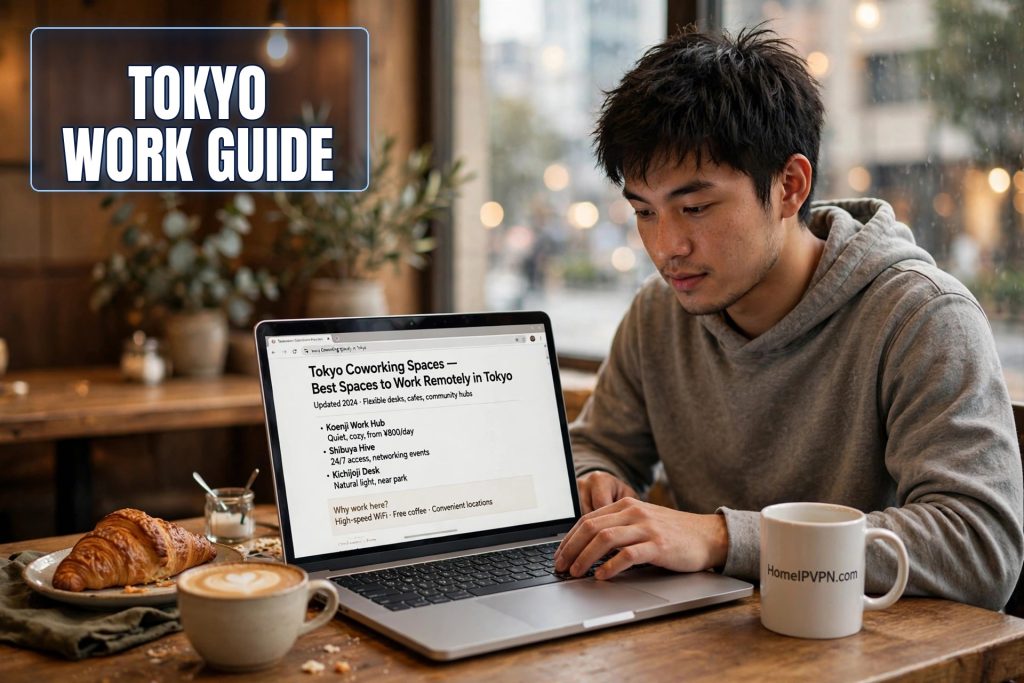
It is 9:40 on a Wednesday morning in Shimokitazawa, and the cafe you found yesterday is already half full. The barista remembers your order, which feels like a small miracle on day three in a new country. You take the corner table, the one with the outlet, open your laptop, and settle into the particular happiness of working well in a beautiful place.
By noon, a quiet line has formed by the door. Your table for one suddenly feels like real estate you are squatting on. You order another coffee you do not really want, and you wonder: am I doing this right? In Tokyo, the answer matters more than in most cities, because the etiquette around shared spaces is real, widely understood, and invisible until you break it.
This is the practical guide to working from Tokyo’s cafes and coworking spaces: where to go, how to behave, and how to build a work routine in a city that rewards those who read the room.
First, understand the two different games
Cafes and coworking spaces in Tokyo are not interchangeable options on a spectrum. They are two different games with different rules, different costs, and different social contracts. Mixing them up is the source of most newcomer friction.
A cafe sells you coffee and a pleasant place to drink it. Your laptop is tolerated, not entitled. The social contract is: you are a customer first, a worker second, and the moment your work inconveniences actual customers, you have broken the deal. This is not hostility. It is just clarity about what the business is.
A coworking space sells you the right to work. Your laptop is the entire point. The social contract is built around productivity: fast internet, desks designed for eight hour days, phone booths, meeting rooms, and other people doing exactly what you are doing. It costs more than coffee, and in exchange you get legitimacy. Nobody will ever side eye you for being on a video call in a coworking space, because that is what the room is for.
The remote workers who thrive in Tokyo learn to use both deliberately: coworking for calls, deadlines, and long days; cafes for writing, thinking, and the pleasure of being out in the city. Assign each task to its rightful venue and both experiences improve.
Tokyo cafes: where to actually work
Tokyo’s cafe scene splits roughly into three types, and knowing which you have walked into saves embarrassment. The kissaten are the old school coffee houses: dark wood, velvet seats, masters who take coffee seriously. They are atmospheric and wonderful, but many are small, some discourage laptops entirely, and the vibe is contemplative rather than productive. Go to a kissaten to think and to drink extraordinary coffee. Do not go to take a sales call.
The third wave specialty shops are the laptop friendliest of the traditional options. These are the bright, minimalist spaces with single origin beans and pastries worth the price. Many have outlets, decent WiFi, and a clientele that includes other people working. They still expect turnover, though. Two to three hours on a single coffee is the comfortable limit in most of them, and during the weekend rush, even that is pushing it.
Then there are the chains and large format cafes, which are the unsung heroes of the Tokyo remote worker. Big Doutor, Excelsior, and similar shops often have counter seating with outlets at every seat, no time pressure during off peak hours, and prices that make a full workday affordable. They are not charming. They are functional, and on a deadline day, functional wins. Nobody writes home about the afternoon they crushed a project at a chain cafe, but everybody has that afternoon.
Neighborhoods matter too. Shimokitazawa, Koenji, and Nakameguro have dense clusters of laptop friendly cafes with a creative crowd. Shibuya and Shinjuku have volume but also crowds and noise. Jimbocho, the book district, has quiet old cafes that feel like libraries. Explore with a simple rule: the further a cafe is from a major station exit, the more likely it is to welcome a lingering worker.
The etiquette that keeps you welcome
Japanese cafe etiquette is not complicated, but it is specific, and visitors who learn it get treated noticeably better. The core principle is consideration for others, expressed through small concrete behaviors.
Buy something every ninety minutes or so. This is the big one. Your seat is inventory, and the purchase is the rent. A coffee every couple of hours is the standard exchange rate for a table. Nursing a single iced coffee for five hours is the fastest way to become the customer the staff complains about after you leave.
Keep your voice down and your calls off speaker, always. Better yet, do not take calls at all in a cafe. Step outside for anything longer than thirty seconds. Tokyo cafes are quiet places, and a loud video call is not a minor faux pas here; it is a genuine disruption that everyone in the room will remember. The coworking space has phone booths for exactly this reason.
Do not spread out. One table, one person, one bag on the floor or the hook under the table, not on the adjacent chair. Do not rearrange furniture. Clean up your own cups and crumbs when you leave. During busy periods, read the room: if people are waiting for tables, finish up and go, even if you just bought a coffee. Generosity with your seat during rush hour is noticed and appreciated.
Finally, respect posted rules absolutely. If a sign says no laptops, or no laptops on weekends, or a ninety minute limit, that is the law of that establishment. Do not negotiate it, do not test it, do not ask for an exception because you are a foreigner. The sign is the answer.
Coworking in Tokyo: what your money buys
Tokyo’s coworking market is mature and varied. At the top end are the international operators with multiple locations, proper phone booths, fast symmetric internet, and communities of English speaking remote workers. These are the easiest soft landing: walk in, buy a day pass, and you have a professional workday sorted within an hour of arrival.
Below that is a rich tier of independent Japanese coworking spaces, often cheaper and often more interesting. Some cater to creators, some to startups, some are basically beautiful libraries with desks. Many offer day passes or short term plans aimed at visitors. The websites are sometimes Japanese only, which is a filter but not a wall: a translation app and a polite email get you surprisingly far.
What to look for when choosing: guaranteed fast internet with a backup line, bookable phone booths or call rooms, comfortable chairs for long days, and opening hours that match your work schedule. If you work with US or European time zones, check closing times carefully, because some spaces shut at 10pm or midnight, which cuts into an afternoon that runs on San Francisco time. A few operate around the clock, and for the night owls among us, those are worth their weight in gold.
Pricing is reasonable by global capital city standards. Day passes typically cost less than a long cafe day with the obligatory purchases, and monthly memberships compete well with what you would pay in London or New York. For your first two weeks in Tokyo, a coworking membership is the single best productivity investment you can make. It removes every variable except the work itself.
Building a weekly rhythm that works
The remote workers who last in Tokyo, rather than burning out in a blaze of novelty, build a rhythm. Here is one that works well. Mornings at the coworking space or home for calls and deep work, when your brain is fresh and the internet is guaranteed. Afternoons at cafes for lighter tasks, writing, and admin, when the city is at its most pleasant and your heavy lifting is done. One or two full coworking days per week for the deadlines that need monastic focus.
Respect the commute in your planning. Tokyo is vast, and “twenty minutes away” on the map can be forty five minutes door to door. Cluster your cafe exploration around the neighborhood you are staying in rather than crossing the city for a famous coffee shop. The best work cafe in Tokyo is the good one within ten minutes of your apartment, not the perfect one an hour away.
And build in a weekly review of what is working. The cafe that was perfect in week one may get crowded once word spreads. Your coworking space may have a noisy neighbor on Tuesdays. Stay flexible, keep a shortlist of three or four reliable spots, and never depend on a single venue. Redundancy is a work strategy, not just a network strategy.
The connectivity layer nobody sees
There is one more venue question, and it is invisible: where does the internet think you are? Every cafe and coworking space in Tokyo gives you a Japanese IP address, which is fine for the work itself and occasionally awkward for everything around the work. Your bank, your employer’s security systems, and various accounts you own all notice the new location, and some of them react badly.
This is the quiet tax on the cafe hopping lifestyle. Every new network is a new location signal, and a week of working from six different Tokyo cafes looks, to an automated fraud system, like someone’s credentials being carried around a foreign city. Because from the system’s perspective, that is exactly what is happening. It does not know you are a legitimate remote worker with excellent taste in coffee.
The fix is to make the venue irrelevant to your digital identity. When your traffic routes through your own home IP address, it does not matter whether you are on coworking fiber in Shibuya or cafe WiFi in Koenji: your bank and your accounts see the same familiar home connection every time. That is the setup HomeIPVPN provides, and it pairs beautifully with the Tokyo work style, because it lets you be promiscuous with venues while staying monogamous with your IP address. Move freely. Log in consistently.
A final word on being a good guest
Tokyo will give remote workers an extraordinary quality of work life if they meet the city halfway. The infrastructure is superb, the coffee is world class, the coworking spaces are professional, and the etiquette, once learned, actually makes shared spaces more pleasant for everyone including you. The workers who struggle are usually the ones who imported their home city’s habits without adjustment: the loud calls, the all day table camping, the assumption that buying one coffee buys the afternoon.
Adjust, and the city opens up. Learn which kissaten welcomes your notebook, which coworking space has the 24 hour plan, which chain cafe near your apartment has the outlet counter. Tip nothing, thank everyone, leave every table cleaner than you found it. These are small things, and in Tokyo, small things are the whole game.
The deeper pattern is one you will recognize from every city in this series: great remote work is about removing friction you cannot see in photographs. The right venue, the right etiquette, and the invisible consistency of a connection your accounts trust. HomeIPVPN handles that last one so thoroughly you will forget it exists, which is the highest praise infrastructure can earn. If you would rather have someone set it up and verify it works before you start cafe hopping, the Pre-Travel Audit & Advisory session is 1 hour, costs $79, and that fee comes straight off the $279 Secure Home IP VPN System session if you go ahead.
Find your corner table. Order the second coffee before you need to. Tokyo rewards those who pay attention.