REMOTE WORK & DIGITAL NOMAD
Costa Rica for Remote Workers: Internet, Banking, and Visa Basics
The toucan lands on the branch outside your window at exactly 6:15 every morning, and you have stopped setting an alarm. You make coffee, open your laptop on…
✓The visa situation, without the✓Internet: the Central Valley vs✓Banking and money in Costa Rica
Quick Answer
Costa Rica is Central America’s most established remote work base, with a dedicated digital nomad visa, solid internet in the Central Valley, and a large expat community. The visa generally requires proof of remote income around three thousand dollars a month and is aimed at workers employed abroad. Internet reliability drops outside San Jose, so choose your base town carefully.
- Visa: The rentista style digital nomad category typically asks for proof of steady remote income; confirm current figures with official sources.
- Internet: San Jose and the Central Valley have reliable fiber; beach towns are improving but vary street by street.
- Banking: ATMs are widespread, cards accepted in most tourist areas, but keep a backup for outages.
- Working online: Costa Rican IPs can look unfamiliar to your home bank, so many nomads keep their logins consistent through HomeIPVPN.
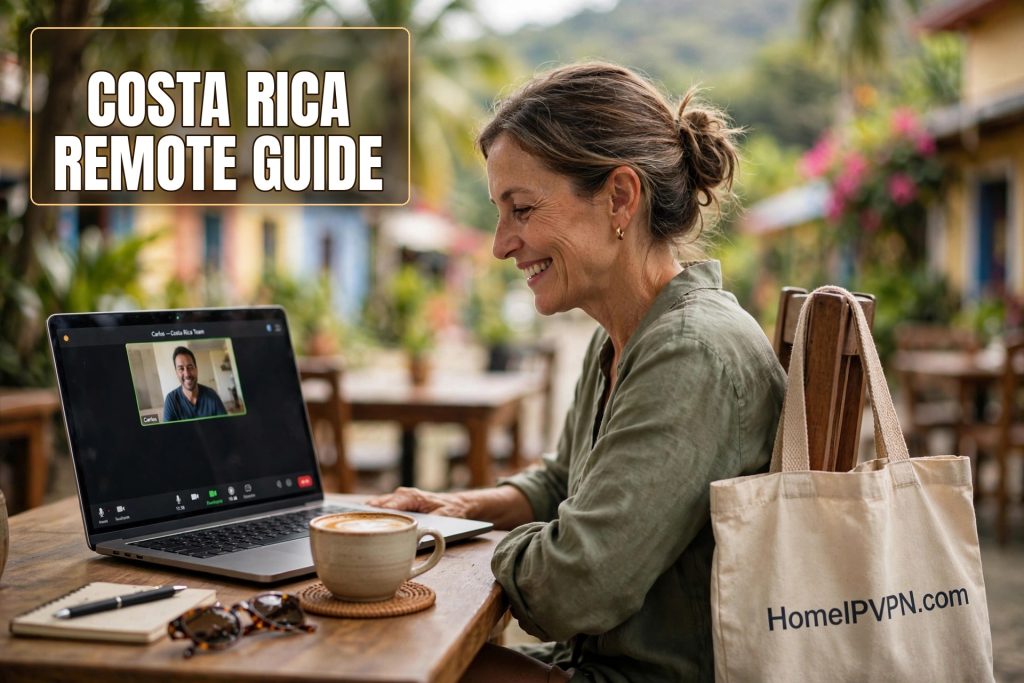
The toucan lands on the branch outside your window at exactly 6:15 every morning, and you have stopped setting an alarm. You make coffee, open your laptop on the terrace, and by seven you are in your inbox with the sound of howler monkeys doing their impression of a motorcycle gang in the distance. This is the Costa Rica pitch, and unlike some nomad destinations, the pitch is mostly true.
But pura vida has paperwork. Costa Rica rewards remote workers who understand the visa situation, the very real gap between San Jose internet and beach town internet, and the banking quirks of a country that runs on a mix of dollars, colones, and patience. This is the starter guide: the honest version.
The visa situation, without the hype
Costa Rica created a specific immigration category for remote workers, often discussed alongside its rentista residency options, aimed at people who earn their living from outside the country. The headline requirement that has been widely reported is proof of a stable remote income around three thousand dollars per month for individuals, higher if you are bringing family. The permit is generally granted for a year and can be renewed.
As with every immigration figure in this series, treat that number as a starting point for your own research, not gospel. Costa Rican immigration rules evolve, consulates interpret them slightly differently, and the only number that matters is the one in force when you apply. Check with the Costa Rican consulate or an immigration lawyer who files these regularly before you make plans around a specific threshold.
What surprises many applicants is the documentation style. Costa Rica’s bureaucracy loves paper, stamps, and apostilles. Your birth certificate, your background check, your proof of income: expect each to need official authentication, and expect the process to take longer than the optimistic timelines quoted online. People who hire a local immigration facilitator consistently report smoother experiences than those who go it alone. This is not a country where DIY immigration saves you money. It costs you months.
One more honest note: a huge number of remote workers in Costa Rica never get any special visa at all. Tourist entries of up to ninety days are common for many nationalities, and the border run to Nicaragua or Panama to reset the clock is a time honored tradition. It exists in a gray area that immigration officials tolerate until they do not, and “until they do not” has ended more than one beach lease. If you are staying long term, do the paperwork properly. The visa exists. Use it.
Internet: the Central Valley vs everywhere else
Here is the single most important fact about working from Costa Rica: internet quality is a function of exactly where you are, and the variance is enormous. The Central Valley, San Jose, Escazu, Santa Ana, Heredia, has proper fiber infrastructure, reliable speeds, and coworking spaces that would not embarrass a European capital. If your job involves daily video calls and you want zero drama, base yourself here. Full stop.
The beach towns are where the dream lives and where the WiFi goes to be tested. Tamarindo, Santa Teresa, Nosara, Puerto Viejo: all have improved dramatically in recent years, and many rentals now advertise fiber. But “fiber in the area” and “fiber in your specific rental” are different statements, and beach town infrastructure is more vulnerable to storms, power cuts, and the general chaos of building networks across jungle terrain. Some streets are perfect. The next street over is a dead zone. There is no substitute for testing the actual address.
The vetting ritual matters more here than almost anywhere: ask for a live speed test from inside the rental, ask whether the connection is fiber or wireless relay, ask what happens during heavy rain, and ask which mobile carrier has the strongest signal as backup. Costa Rica’s mobile data is decent and affordable, and a phone hotspot has saved more beach town workdays than any other single technology. Consider it mandatory equipment, not a backup plan.
Power cuts deserve their own mention. They happen, especially in coastal and rural areas during the rainy season, and they take your router with them. A small UPS battery backup for your router and laptop costs little and buys you hours of continued work through the outages that everyone else is tweeting about. The nomads who have been in Costa Rica for years all own one. That tells you everything.
Banking and money in Costa Rica
Costa Rica runs on two currencies in practice: colones for daily life and dollars for big things like rent. Many landlords quote rent in dollars, and ATMs dispense both. Your foreign cards work widely in tourist areas, supermarkets, and restaurants. The further you get from the tourist track, the more cash matters, and the green season habit of carrying colones will serve you well everywhere.
ATM fees and foreign transaction fees are the slow leak in most nomads’ budgets here. A card with no foreign transaction fees is not a luxury in Costa Rica; it is basic equipment. Withdraw larger amounts less often to minimize per transaction ATM fees, use the ATMs inside banks rather than standalone tourist ATMs with worse rates, and always choose to be charged in colones rather than your home currency when the machine offers the choice. The machine’s conversion rate is never in your favor.
Opening a local bank account as a non resident is difficult, which surprises people given how many foreigners live here. The workarounds are well established: keep your home accounts, use a multi currency service for transfers, and pay rent by international transfer or in cash as your landlord prefers. Do not arrive assuming you will open a local account in week one. You almost certainly will not.
And then there is the fraud alert problem, which in Costa Rica has a specific flavor. Your home bank sees logins from San Jose, then Tamarindo, then a coworking space in Nosara, a new IP every few days, and it does the math that fraud systems do. Frozen accounts are a rite of passage here, usually striking right when you need to pay rent or receive a client payment. The nomads who never experience it are the ones whose banks never see Costa Rica at all, because their connection always shows the same home IP address. That is what HomeIPVPN sets up: your traffic exits through your own residential connection back home, so every login looks like it is coming from your living room, and the fraud algorithm never wakes up.
Where to base yourself: an honest breakdown
San Jose and the Central Valley are the grown up choice. Escazu and Santa Ana have the best infrastructure, modern apartments, international supermarkets, and the largest coworking scene. It is not the prettiest part of Costa Rica, and nobody’s Instagram is full of Escazu sunsets, but if your priority is getting work done reliably, this is where the work gets done. Many long term nomads live here and take beach weekends, which is arguably the best of both worlds.
Tamarindo is the most developed beach nomad hub, with the most coworking options on the coast, a big international community, and infrastructure that mostly holds up. It is also the most expensive beach town and the most touristed, which are two ways of saying the same thing. Santa Teresa draws the surf crowd and has improved connectivity, but it is still remote enough that you should vet carefully. Nosara has a strong wellness nomad community and decent internet in the main areas. Puerto Viejo on the Caribbean side is beautiful, affordable, and the most variable for connectivity: paradise with an asterisk.
La Fortuna and the Arenal area deserve a mention for a different lifestyle: volcano views, hot springs, adventure tourism, and surprisingly decent internet in the town itself. It is not a beach, which for some people is a feature. Monteverde is stunning and, for remote work, a stretch: gorgeous cloud forest, limited infrastructure, better for a long weekend than a work base.
Cost of living: the honest numbers shape
Costa Rica is not the cheap paradise its reputation suggests. It is affordable compared to the US or Western Europe, but it is the most expensive country in Central America by a clear margin, and imported goods, cars, and electronics carry heavy taxes. A comfortable nomad life in the Central Valley costs meaningfully less than a big US city but more than most of Southeast Asia or the cheaper Balkans. Beach towns add a premium on top, especially for housing.
The budget works when you live a bit like a local: shop at ferias, the farmers markets, eat the casado lunch special, and rent outside the gringo bubble. It breaks when you eat imported food, drink imported wine, and rent the villa with the infinity pool. This is true everywhere, but Costa Rica’s price floor is higher than the region, so the lifestyle gap between local style and expat style living is wider than newcomers expect.
Healthcare is a genuine bright spot. The public system is decent, private care is good and affordable by US standards, and many nomads carry international insurance plus pay out of pocket for routine care. Dental work and minor procedures are famously affordable. It is one of the quiet advantages of basing yourself here long term.
Making it work long term
The nomads who thrive in Costa Rica share a few habits. They base themselves where the internet is boring and reliable, and visit the beautiful places on weekends. They carry backup power and backup data. They do their immigration paperwork properly instead of living on border runs. They learn enough Spanish to handle landlords, mechanics, and bureaucracy, because English gets you through the tourist layer and stops working the moment something actually needs fixing.
They also sort their digital infrastructure before they arrive. Banking that works from day one, logins that do not trigger fraud alerts, a connection their employer trusts. These are not exciting purchases. They are the difference between a pura vida work life and a pura troubleshooting work life.
Costa Rica will give you the toucan mornings and the terrace office and the weekend waterfalls. It asks in return that you respect its bureaucracy, its rainy season, and its very real infrastructure gaps outside the valley. That is a fair trade, and thousands of remote workers make it happily every year.
The thread connecting the visa queue, the beach town WiFi gamble, and the frozen bank account is the same: the friction of living in one place while your administrative life lives in another. Smoothing that friction is the entire job, and the banking piece is the one you can solve permanently before you ever board the plane. A constant home IP means your accounts never notice you left, which is exactly what HomeIPVPN was built to provide. If you would rather have someone set it up and verify it works before you go, the Pre-Travel Audit & Advisory session is 1 hour, costs $79, and that fee comes straight off the $279 Secure Home IP VPN System session if you go ahead.
Pura vida is not the absence of problems. It is the presence of good coffee while you solve them.