REMOTE WORK & DIGITAL NOMAD
Working Remotely From Japan: Internet, SIM Cards, and Banking Basics
You step off the plane at Narita, follow the signs through the gleaming terminal, and within twenty minutes of landing you are holding a small device the size…
✓Internet in Japan: the good news✓Pocket WiFi vs SIM card: the real✓Buying and activating: what
Quick Answer
Japan has some of the world’s fastest internet, and getting connected as a visitor is straightforward: pocket WiFi rentals and tourist SIM cards are available at every major airport. Banking needs more planning, since Japan is still cash friendly and foreign cards do not work everywhere. Sort your SIM at the airport, carry yen for small shops, and keep your home banking access stable.
- Internet: Rent pocket WiFi at the airport or buy a tourist SIM; both give fast, reliable data from day one.
- SIM cards: Data only tourist SIMs are easy to find, but check whether you need a Japanese number for verifications.
- Banking: Carry cash for small shops and rural areas; use convenience store ATMs for withdrawals with foreign cards.
- Home banking: Logins from Japan often trigger fraud alerts, so many remote workers keep a steady home IP through HomeIPVPN while abroad.
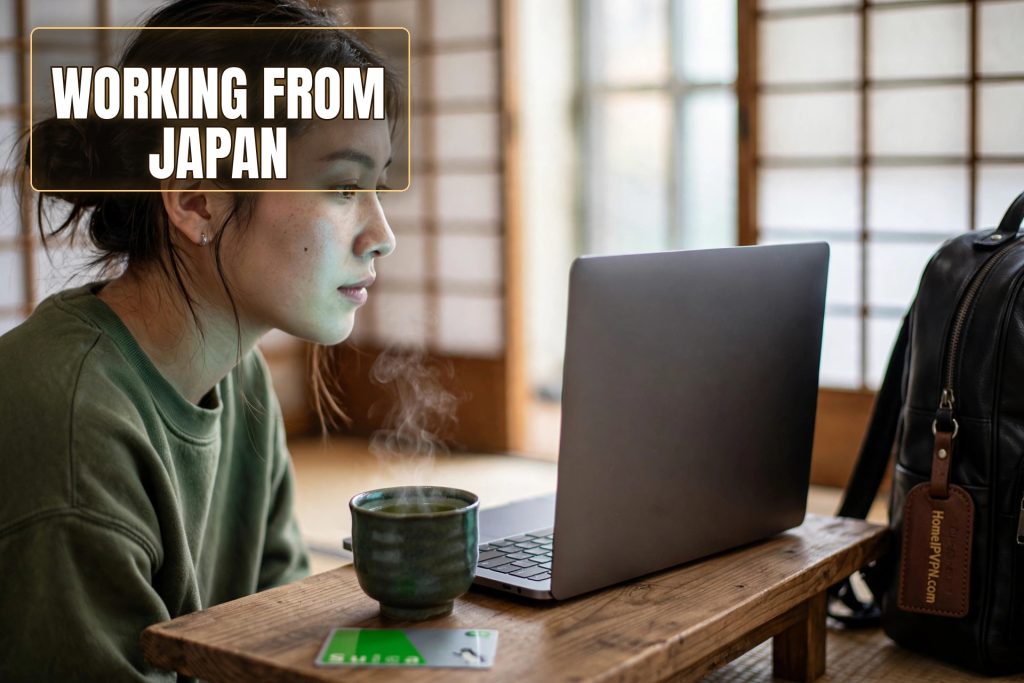
You step off the plane at Narita, follow the signs through the gleaming terminal, and within twenty minutes of landing you are holding a small device the size of a matchbox that gives you faster internet than your apartment back home ever did. This is Japan’s party trick. The country that still faxes is also the country where a tourist can get gigabit grade connectivity before they have even cleared customs.
But working remotely from Japan for weeks or months involves more than fast WiFi. There is the SIM card question, the cash question, the banking question, and a handful of small frictions that surprise even experienced travelers. This is the practical guide: internet, SIM cards, and banking, the three pillars your work will stand on.
Internet in Japan: the good news first
Japan’s fixed internet is among the fastest on the planet, and it shows up where you need it. City apartments, business hotels, and coworking spaces in Tokyo, Osaka, Kyoto, and Fukuoka routinely deliver speeds that make video calls boring in the best way. If you are renting an apartment for a month or more, the connection will almost certainly be fine. Ask anyway, because “almost certainly” is not a business continuity plan, but the base rate of good internet in Japan is extraordinarily high.
Coworking spaces deserve a special mention because Japan does them well. Tokyo has dozens, from international chains to tiny neighborhood spaces with six desks and excellent coffee. Osaka and Fukuoka have growing scenes. Day passes are common, monthly memberships are reasonable by global city standards, and the etiquette is what you would expect: quiet, clean, respectful. Book a tour on your first day in a new city and you will have a reliable work base within the week.
Hotel WiFi is the one weak spot, and it is weak everywhere in the world, not just Japan. Business hotels often have perfectly adequate connections, but traditional ryokan and budget guesthouses can be spotty, especially in older wooden buildings where the signal dies between floors. If you are hopping between accommodations, your mobile data setup matters more than any single hotel’s router.
Pocket WiFi vs SIM card: the real decision
Every remote worker landing in Japan faces the same choice at the airport, and the sales counters for both options sit side by side in arrivals, which tells you how common this decision is. Pocket WiFi is a small battery powered hotspot you carry in your pocket or bag. It creates a WiFi network for your laptop, phone, and tablet simultaneously. Tourist SIM cards go directly into your phone and give it local data.
Pocket WiFi wins if you carry multiple devices or travel with a partner. One rental covers the laptop, the phone, and the tablet, and the battery lasts a full workday. The downside is one more thing to charge and carry, and if you leave it at the hotel, your laptop has no connection. Prices are reasonable for the speeds you get, and you return the device by mail or at the airport when you leave.
A SIM card wins for simplicity. Nothing extra to carry, nothing extra to charge, and your phone just works. The catch is that most tourist SIMs are data only, meaning no Japanese phone number for voice calls or SMS. That matters more than people expect, because some Japanese services, delivery apps, restaurant reservation systems, and even some WiFi logins want to verify you with a local number. If your work involves receiving SMS codes on your home number anyway, you will be juggling two phones or a dual SIM setup regardless.
The practical answer for most remote workers: get the SIM for your phone and rent pocket WiFi if you are doing heavy laptop work away from your accommodation. Belt and suspenders. Connectivity is the one thing you never want to be troubleshooting during a client call.
Buying and activating: what actually happens at the airport
The process is refreshingly painless. At Narita, Haneda, and Kansai airports, the arrivals hall has counters and vending machines selling both options, with English speaking staff who do this hundreds of times a day. You will need your passport. Payment by foreign credit card is universally accepted at these counters. Activation takes minutes, and the staff will help you configure your phone if you ask.
One warning that catches people: your phone must be unlocked to accept a Japanese SIM. If you bought your phone on a carrier contract that locks it to your home network, a tourist SIM will not work, and you will discover this standing in the arrivals hall. Check with your carrier before you fly. Most carriers now unlock phones on request or automatically after the contract terms are met, but it takes a phone call or a settings change you do not want to be doing on airport WiFi.
If you are staying longer than a month, look into longer term rental plans rather than stacking tourist SIMs. Several companies cater specifically to extended stay foreigners with monthly pocket WiFi contracts that work out cheaper than the tourist rates. A quick search before you fly will surface the current options, and the savings over three months are meaningful.
Banking basics: cash is not dead here
Japan has a reputation as a futuristic country, and in many ways it is, but the payment landscape will surprise you. Cash remains deeply embedded in daily life. Small restaurants, local shops, temples, rural businesses, and many bars are cash only or cash preferred. The cashless trend is real and growing, especially in cities and chain stores, but “just use your card everywhere” is not yet true in Japan the way it is in, say, Sweden.
Your foreign credit and debit cards will work fine at major retailers, hotels, convenience stores, and most restaurants in big cities. Visa and Mastercard have the widest acceptance. American Express is accepted at upscale places and less so elsewhere. Before you go, tell your bank you are traveling, or better yet, make sure your account is set up so travel does not trigger a fraud lock in the first place.
For cash, the rule every Japan traveler learns: use the ATMs in convenience stores. Seven Eleven, FamilyMart, and Lawson ATMs reliably accept foreign cards and have English menus. Post office ATMs work too. Regular bank ATMs are hit or miss with foreign cards and sometimes keep bankers hours, literally shutting down in the evening. The convenience store ATM at 11pm is one of Japan’s great unsung infrastructures. Learn its location near your accommodation on day one.
The fraud alert problem, and how to dodge it
Now the part that actually ruins trips. Your home bank’s security system builds a profile of your normal behavior: where you log in from, what networks you use, what times you are active. Then you fly to Japan, and every signal changes at once. New country, new IP addresses, new networks, activity at hours that look like 3am back home. To a fraud algorithm, you look exactly like a stolen credential being tested from abroad.
The result is the classic nomad nightmare: you try to pay your rent back home, transfer money to your travel account, or just check a balance, and the account is frozen pending verification. Verification usually means a code sent to your home phone number, which you may not be receiving if you swapped SIMs, or a phone call you cannot easily take at 2am Tokyo time. People lose days to this. People have missed rent payments over this.
There are partial fixes. Keeping your home number active on an eSIM so verification codes still arrive is smart and cheap. Notifying your bank of travel helps, though it helps less than banks imply, because the algorithms and the travel notice systems do not always talk to each other. Using your bank’s app consistently rather than the website can help, since the app carries device identity the website does not.
The structural fix is to remove the anomaly at its source. If your connection always appears to come from your home IP address, the fraud system never sees Japan at all. It sees you, at home, doing normal things, because as far as the network is concerned, that is true. This is what a home IP VPN does: it routes your traffic through your own residential connection, so your digital location stays put while your physical location changes. HomeIPVPN builds exactly this for remote workers, and it is the kind of setup where the best outcome is that nothing ever happens. No frozen accounts, no verification gauntlets, no 2am phone calls to a fraud department. Just banking that works, in Kyoto as at home.
Money movement: getting paid and paying bills
A word on the plumbing of nomad finances while in Japan. If clients pay you in your home currency to your home accounts, nothing changes except the fraud alert risk discussed above. If you need to move money internationally, do it before you need it, because international transfers can take days and the timing is the worst when you are trying to pay a deposit on a monthly apartment.
Wise, Revolut, and similar services are popular with nomads in Japan for a reason: multi currency accounts, reasonable exchange rates, and cards that work well locally. Having one of these as a secondary account is cheap insurance. Your primary bank stays primary, but the backup means a frozen primary account is an annoyance rather than a crisis.
One Japan specific note: some services and subscriptions price in yen or require Japanese payment methods. If you are signing a monthly apartment lease, the agency may want a Japanese bank account or a domestic transfer, which as a visitor you generally cannot open. This is where longer stay nomads sometimes hit a wall, and it is worth clarifying payment methods with any landlord before you commit. Tourist friendly monthly apartment services exist precisely to bridge this gap, and they are worth the premium for the paperwork they absorb.
A practical arrival checklist
Land with a plan and the first week is smooth. Before you fly: unlock your phone, set up an eSIM or backup for your home number, notify your bank, and make sure your home IP setup is tested and working. At the airport: buy the SIM or rent the pocket WiFi, withdraw yen from a convenience store ATM, and screenshot your accommodation address in Japanese for taxi drivers. Day one: find the nearest convenience store with an ATM, test your work video call setup, and buy a transit card.
None of this is difficult. All of it is the difference between a working trip and a troubleshooting trip. Japan rewards preparation more than most countries, because the systems are excellent but specific, and “excellent but specific” punishes improvisation.
The pattern across internet, SIM, and banking is the same: Japan gives you world class infrastructure the moment you plug into it correctly, and mild chaos the moment you assume it works like home. Plug in correctly. Test your home IP connection before you leave, keep cash in your pocket alongside your cards, and let the world’s best convenience stores handle the rest.
Getting paid, staying connected, and accessing your own money are the unglamorous foundations every remote stint stands on, and they are exactly the foundations that wobble when your digital location stops matching your real one. Keeping your home IP constant is the simplest way to keep all three steady, which is why HomeIPVPN exists in the first place. If you would rather have someone set it up and verify it works before you fly, the Pre-Travel Audit & Advisory session is 1 hour, costs $79, and that fee comes straight off the $279 Secure Home IP VPN System session if you go ahead.
Welcome to Japan. The WiFi is fast, the ATMs glow at midnight, and the coffee masters have been waiting for you.