REMOTE WORK & DIGITAL NOMAD
Japan Digital Nomad Visa: The Income Requirement Explained Simply
Picture this. You are in a kissaten in Kyoto, one of those old coffee houses with velvet chairs and a master who has been pouring the same perfect cup for…
✓What Japan actually offers remote✓The income requirement, in plain✓Why Japan set the bar where it did
Quick Answer
Japan’s digital nomad visa sets a high income bar, widely reported around ten million yen per year, which puts it out of reach for most early career remote workers. It allows a stay of up to six months for citizens of certain countries, and you must work for employers or clients outside Japan. Always confirm the current threshold and eligible nationalities with official Japanese sources before planning around it.
- High bar: The annual income requirement is set far above most countries’ nomad visas, targeting established high earners.
- Six months: The visa allows up to six months in Japan, not a full year, and it cannot be extended in country.
- Who qualifies: Your nationality must be on the eligible list, and your income must come from outside Japan.
- Working from Japan: Japanese logins can trigger your home bank’s fraud alerts, which is why many nomads route through HomeIPVPN to keep a familiar home IP.
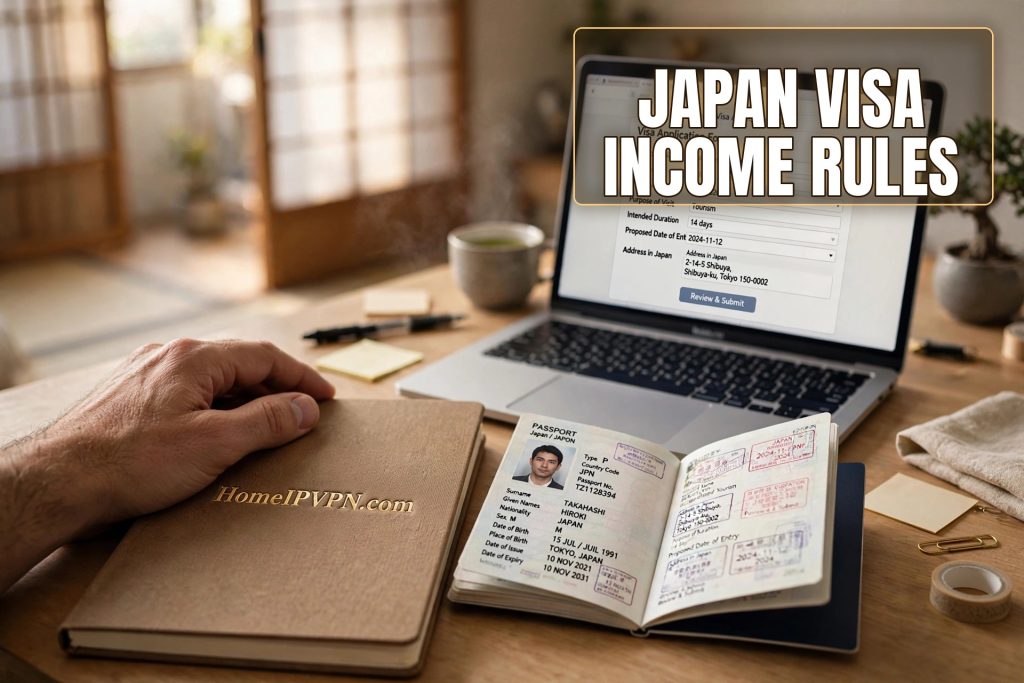
Picture this. You are in a kissaten in Kyoto, one of those old coffee houses with velvet chairs and a master who has been pouring the same perfect cup for forty years. Outside, the afternoon light hits the temple roof across the street. Your laptop is open, your code is compiling, and for a moment everything about the digital nomad dream feels true.
Then your friend messages you: “Did you see Japan finally has a digital nomad visa?” You look it up. And then you see the income requirement, and the dream does some quick math, and the math is not kind to most of us.
Japan’s digital nomad visa is real, it is genuinely useful for the right person, and its income bar is one of the highest in the world. Let us talk honestly about what it asks for, who it is actually for, and what your options are if you love Japan but your paycheck does not clear the bar.
What Japan actually offers remote workers
Japan launched its digital nomad visa to let remote workers live in the country for up to six months while working for foreign employers or clients. The key word in that sentence is six months. Unlike the year long permits offered by many European countries, Japan’s version is closer to an extended working visit. You arrive, you work remotely for half a year, and then you leave. It cannot be renewed or extended from inside Japan.
That six month cap shapes everything about how you should think of this visa. It is not a base. It is a season. A very good season, in one of the most fascinating countries on earth, but a season with an end date stamped into it from the start. If you are imagining a year in Tokyo building a life, this visa is not the vehicle. If you are imagining six months of working from Osaka, Fukuoka, Sapporo, and the countryside in between, now we are talking.
The visa also comes with a nationality condition. It is available to citizens of countries that have tax treaties and visa exemption arrangements with Japan, which covers a long list including the United States, the United Kingdom, Australia, and most of Europe, but not everyone. Check the current eligible nationality list on an official Japanese government or embassy site before you invest any hope in this plan.
The income requirement, in plain numbers
Here is the number that stops most people cold: the income threshold has been widely reported at around ten million yen per year. At typical exchange rates that lands somewhere in the ballpark of sixty to seventy thousand US dollars, though the yen moves around enough that the dollar figure shifts with it. Whatever the exact conversion on the day you read this, it is a lot of money, deliberately so.
To put it in context, most digital nomad visas in Europe and Latin America set their bars somewhere between twenty and forty thousand dollars a year. Japan’s is roughly double that. This is not an accident or a rounding error. Japan designed this visa for established professionals, senior engineers, successful freelancers, executives working remotely, people whose income clearly places them in the top tier of remote earners.
As with every figure in this guide, verify the current number with official sources before you act. Governments adjust thresholds, exchange rates move, and a blog post is a starting point, not a legal reference. But the structural fact is unlikely to change: Japan is not trying to attract budget backpackers with laptops. It is courting high earners who will spend generously for six months and leave.
Why Japan set the bar where it did
It helps to understand the logic, because it tells you whether the bar might move. Japan is an expensive, high wage country with a strong currency tradition and a government that thinks carefully about who it invites in. A low income threshold would raise concerns about visitors working illegally in the local economy or straining public services. A high threshold sidesteps all of that: at ten million yen a year, nobody worries you are coming to take a local job.
There is also a tourism strategy angle. Japan wants visitors who spend. A remote worker earning well above the threshold, living in Japan for six months, eating out, traveling domestically, and paying for accommodation is an economic win with almost no downside for the host country. The visa is less an immigration policy and more a premium tourism product with a work permission attached.
None of this is a criticism. Countries get to choose who they invite and on what terms. But it does mean you should read the visa for what it is: Japan saying “we would love to host successful remote professionals for a season.” If that describes you, wonderful. If it does not, Japan still has plenty of doors open, just different ones.
Who the visa is really for
Let us get concrete. The visa fits a senior software engineer at a US tech company working fully remote. It fits a freelance consultant with a roster of corporate clients and a strong year behind them. It fits a founder whose startup pays them a proper salary, or a remote executive managing a distributed team. The common thread is documented, stable, high income from sources outside Japan.
It does not fit a junior freelancer building a client base, a content creator with unpredictable months, or anyone whose income technically averages out but looks chaotic on paper. Consulates want to see clean proof: tax returns, employment contracts, bank statements showing regular high deposits. If your income is real but messy, you will need to work harder to document it, and even then the decision is not guaranteed.
There is also a subtle point about how income is counted. The requirement is about your personal income from remote work, not household wealth, not savings, not a partner’s salary. A healthy savings account does not substitute for the income figure. If you are close to the line, talk to an immigration professional who handles Japan cases before you assemble the application. Being close is the most expensive place to be wrong.
What if you do not clear the bar: real alternatives
Most remote workers who love Japan will never qualify for this visa, and that is fine, because Japan is one of the easiest developed countries to spend serious time in as a visitor. Citizens of many countries can enter visa free for up to ninety days, which is a full season of working from Japan if your employment situation allows it. Ninety days in Japan is not a consolation prize. It is most of a cherry blossom to rainy season arc, or an entire autumn of perfect weather.
The ninety day entry is for tourism, and you should be honest with yourself about what that means. Many remote workers quietly keep up with email and light tasks while traveling, which is a gray area every nomad navigates personally. What you should not do is treat a tourist entry as a work visa or lie to an immigration officer about your plans. Japan’s immigration officials are professional and thorough, and “I am here for tourism” should be a true statement about the primary purpose of your trip.
Another path people overlook: the working holiday visa. If you are young enough to qualify, usually under thirty depending on your country, Japan’s working holiday arrangements let you live and work in the country for up to a year with far less stringent financial requirements. It is age gated, which is unfair and also the deal, but if you are eligible it is a far more flexible door than the nomad visa.
And there is always the multi trip strategy. Ninety days in Japan, then time elsewhere in Asia, then back again later, respecting the entry rules each time. Plenty of long term nomads have effectively lived a Japan centered life for years this way, in seasons rather than in one continuous stay. Immigration officers can ask questions if they see a pattern of back to back long stays, so keep your travel genuine and your story straight.
The money practicalities nobody warns you about
Japan is famously still a cash friendly society in transition. Your foreign cards will work in most city establishments and all convenience stores, but the smaller the town and the older the shop, the more likely you are to need yen in your pocket. Get a feel for withdrawing cash early in your stay, and learn which ATMs accept foreign cards, because not all of them do. The ones in convenience stores are your most reliable bet.
Banking from Japan brings the classic nomad headache. Your home bank sees logins from Tokyo, on networks it has never seen, possibly at hours that look odd against your old pattern, and its fraud system does what it was built to do. Getting locked out of your own money while standing in a foreign convenience store is a rite of passage nobody wants. The travelers who skip this rite are the ones whose logins never look foreign in the first place.
That is the practical case for keeping a home IP address while you travel. When your connection routes through your own residential line back home, your bank sees the same familiar address it has always seen, and the fraud algorithm stays asleep. HomeIPVPN sets exactly this up for remote workers: one stable home IP that goes where you go, so a Tuesday in Kyoto looks, to your bank, like a Tuesday at home. It is unglamorous infrastructure, and it is the difference between a smooth six months and a month of verification codes.
Is it worth chasing?
Here is the honest summary. If you comfortably clear the income bar, the visa is a clean, legal way to spend six remarkable months in Japan, and you should take it seriously. The application is paperwork, not a lottery, and for the right profile it is very achievable. Six months is enough to learn a neighborhood, build routines, take weekend trips across the country, and actually understand a place rather than just photograph it.
If you do not clear the bar, do not contort your life around it. Japan rewards visitors enormously, the ninety day entry is generous, and the working holiday route exists for the young. Forcing an application you are likely to lose wastes months and money, and the rejection can complicate future applications. Play the hand you have. Japan will still be there, and the kissaten will still be pouring.
Either way, the pattern is the same one you will see across every country in this series: the visa gets you in the door, but the invisible infrastructure decides how smooth the stay is. Money you can access, logins that work, a connection your bank trusts. Those are not the romantic parts of the nomad dream, but they are the load bearing walls. Sort them before you fly, and the dream gets to be about the dream.
Japan’s income bar exists because the country wants visitors whose presence is unambiguously easy: no strain, no gray areas, just six months of someone spending well and working quietly. That desire for a frictionless stay is exactly what HomeIPVPN was built to serve on the technical side, by making your digital presence as smooth and unremarkable as your physical one. If you would rather have someone set it up and verify it works before you go, the Pre-Travel Audit & Advisory session is 1 hour, costs $79, and that fee comes straight off the $279 Secure Home IP VPN System session if you go ahead.
However long you get, spend at least one slow afternoon in a kissaten. Some things should not be rushed.