REMOTE WORK & DIGITAL NOMAD
Getting Paid as a Freelancer Abroad: The Options in Plain English
Priya had just finished her biggest project yet: six weeks of brand design for a startup in Berlin, invoiced at $4,800. She sent the invoice feeling proud. The
✓Direct bank transfer: the old✓Wise: the option nomads mention✓PayPal: everybody knows it,
Quick Answer
Freelancers working abroad usually get paid through Wise, PayPal, direct bank transfers, or a mix of several. Each option trades off speed, fees, and convenience differently, and the best choice depends on your client, your amounts, and how you need to spend the money. Keep at least two working payment paths so one hiccup never strands you.
- Wise is the traveler favorite: freelancers report fair exchange rates and low fees for moving money between currencies and countries.
- PayPal is familiar but costly: almost every client can pay through it, but currency conversion fees add up fast on regular income.
- Bank transfers suit big invoices: slow and sometimes expensive, but simple and trusted for large client payments.
- Keep your access steady abroad: logging in from a consistent home location, for example with a HomeIPVPN home ip vpn setup, keeps payment platforms from flagging your travel as suspicious.
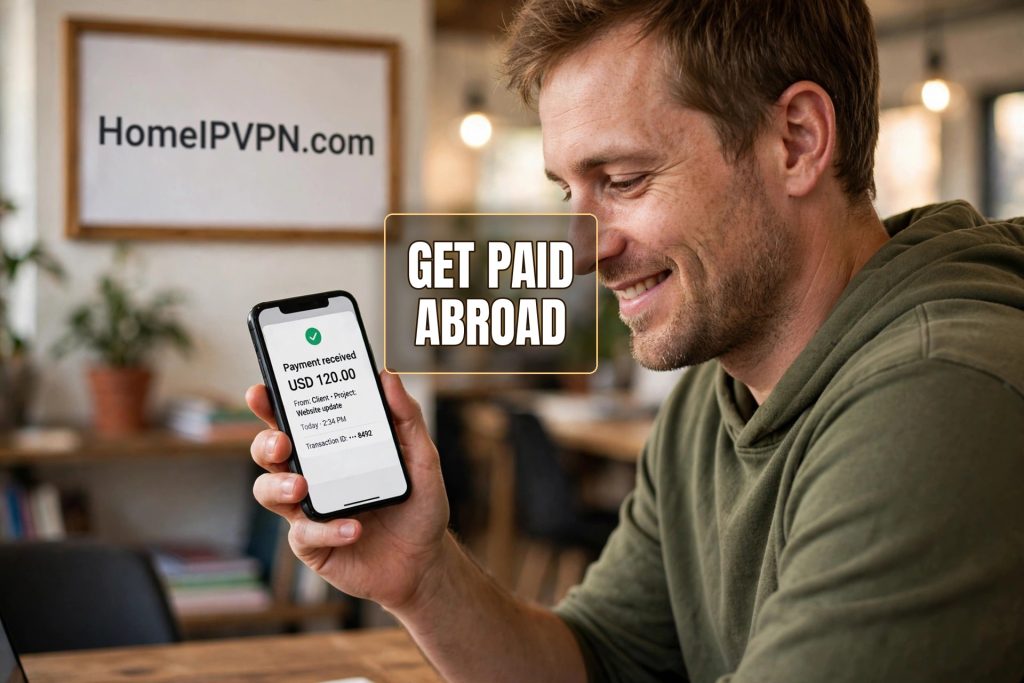
Priya had just finished her biggest project yet: six weeks of brand design for a startup in Berlin, invoiced at $4,800. She sent the invoice feeling proud. The client replied within the hour: “Looks great. How do you want to be paid?” Priya stared at the message. She was sitting in a coworking space in Ho Chi Minh City, her bank account was back in India, and she had absolutely no idea what the right answer was. Wire transfer? PayPal? Something called Wise that other nomads kept mentioning? She did not want to lose a chunk of her fee to a bad choice, and she did not want to look unprofessional by asking the client to explain it to her.
Every freelancer abroad hits this moment. Getting paid sounds like the easy part of freelancing until you are the one choosing the rails your money travels on. The good news is that the options are fewer than they seem, and each one is simple once someone explains it in plain words. This is that explanation.
Direct bank transfer: the old reliable
A direct bank transfer, often called a wire transfer, means the client’s bank sends money straight to your bank account. You give the client your account details (account number, bank name, and a code called a SWIFT or BIC code that identifies your bank internationally), and the money travels through the banking system to you. No apps, no middlemen accounts, just bank to bank.
Freelancers report that wires are trusted and familiar, which makes them a comfortable choice for large invoices. Clients’ finance departments understand them, and there is a clear paper trail. The downsides are speed and cost. International wires typically take a few business days to arrive, and fees can bite at both ends: the client’s bank may charge to send, intermediary banks sometimes take a cut along the way, and your bank may charge to receive. For a $5,000 invoice, travelers commonly report losing somewhere in the tens of dollars to fees, though the exact amount varies by bank and corridor. Currency conversion happens at your bank’s rate, which is rarely the best rate available.
Wires make the most sense for big, infrequent payments from corporate clients. For smaller weekly or monthly amounts, the fees sting proportionally more, and most traveling freelancers graduate to other options quickly.
Wise: the option nomads mention first
Wise started as TransferWise, and it is the name you will hear most in any coworking space. In plain English, Wise gives you a multi-currency account: one account that can hold dollars, euros, pounds, and dozens of other currencies, each with its own local account details. So a US client can pay you as if they are paying a US bank account, a European client as if they are paying a European one, and you receive it all in one place.
Why freelancers like it: the exchange rates are close to the real market rate you see on Google, and the fee is shown upfront before you convert, so there are no surprises. Moving money between your own currencies is fast, often same-day, and spending works through a debit card that converts at that same fair rate. For someone earning in dollars, spending in Vietnamese dong, and keeping savings in euros, it is hard to beat for simplicity.
The honest caveats: Wise is not a bank (more on that in another post), so it is best used as a money-moving tool rather than the only place your savings live. Freelancers also report that brand-new accounts sometimes face extra verification on the first large transfer, so it is worth setting up and verifying your account before the big invoice lands, not after. And like every financial service, it can ask questions about unusual activity, which is one more reason to keep your login patterns steady while traveling.
PayPal: everybody knows it, everybody pays for it
PayPal is the option your clients already understand. Almost any business on earth can send a PayPal payment, setup takes minutes, and money arrives quickly. For small jobs and first-time clients, that familiarity is genuinely valuable. Many freelancers keep PayPal as their “yes, I can take that” fallback for exactly this reason.
The catch is cost. PayPal’s fees on receiving business payments are widely reported as a few percent, and its currency conversion adds its own margin on top. On a $500 invoice that might mean $20 or more disappearing, which adds up fast if PayPal is your main channel. Travelers also report that PayPal’s fraud systems are jumpy: logging in from a new country, receiving an unusually large payment, or withdrawing to a new bank account can trigger holds where your money sits frozen for days while PayPal reviews it. Keeping your logins looking like home helps here too, which is one more reason traveling freelancers route their sessions through HomeIPVPN. None of this makes PayPal bad. It makes PayPal expensive and occasionally slow, which is fine for convenience and painful as a primary income pipe.
A practical middle path many freelancers use: accept PayPal from new or small clients, then move regular clients to Wise or bank transfer once trust is established. You get the convenience where it matters and keep the fees where they belong.
Payoneer and the rest of the field
Payoneer is another name you will hear, especially from freelancers working with clients in the US, Europe, and parts of Asia. It works similarly to Wise in spirit: you get receiving accounts in several major currencies, clients pay locally, and you withdraw to your own bank. Freelancers report that it is particularly common in certain industries and regions, and some clients even prefer it. Fees and speeds vary, so it is worth comparing against Wise for your specific currencies before committing.
Beyond that, the field gets exotic fast: cryptocurrency, regional wallets, and various fintech apps. Unless you have a specific reason, most traveling freelancers do fine ignoring all of it. Three solid options, Wise, PayPal, and your bank, cover nearly every client you will ever meet. Complexity is the enemy here. Every extra app is another password, another verification process, and another thing that can break while you are twelve time zones from home.
Getting the money into your hands
Receiving money is only half the job. You also need to spend it where you are. This is where the multi-currency approach pays off. With a Wise-style account and its debit card, you can pay for your coworking membership in dollars, withdraw local currency from an ATM, and convert only what you need, when you need it. Travelers report that converting small amounts as you go beats converting a whole invoice at once, because you keep flexibility if rates move or plans change.
A few practical habits from long-term nomads: keep a local buffer of cash for places where cards are unreliable, know your ATM withdrawal limits before rent day, and never convert your entire invoice into a currency you cannot easily convert back. Exchange rates move, and the freelancer who converted everything to dong the week before flying to Thailand has a story they will tell you at length.
Keep two paths open, always
Here is the rule experienced freelancers repeat like a mantra: never depend on a single way of getting paid. Accounts get flagged, cards get eaten by ATMs, verification requests arrive at the worst possible moment. If Wise is your main channel, keep PayPal verified and ready. If clients wire to your home bank, keep a fintech account as backup. The second path does not need to carry your whole income. It just needs to exist, verified and tested, before you need it.
Part of keeping those paths open is keeping your access to them boring and predictable. Payment platforms watch for unusual login patterns, and a freelancer whose account is suddenly accessed from a new country on a new device looks, to an automated system, like a potential account takeover. Logging in from a consistent home location removes that whole category of worry. A home ip vpn setup gives you exactly that consistency, and many freelancers have HomeIPVPN set it up so their financial accounts always see them coming from home.
Priya’s story ended well, by the way. She asked in a nomad group chat, set up Wise that afternoon, and the Berlin client paid her US details two days later. The fee was small, the rate was fair, and she looked like a professional who had done it a hundred times. Now she has.
The root cause of payment headaches abroad is simple: money has to cross borders, change currencies, and pass fraud checks, all while you keep moving. That is the problem HomeIPVPN was built to solve on the access side, giving you one steady home connection so your payment platforms never see a reason to worry. If you would rather have someone set it up and verify it works, the Pre-Travel Audit & Advisory session is 1 hour, costs $79, and that fee comes straight off the $279 Secure Home IP VPN System session if you go ahead. You can book a Pre-Travel Audit & Advisory session whenever you are ready.
Your money should travel as easily as you do.

