REMOTE WORK & DIGITAL NOMAD
How Nomads Handle Taxes While Moving Between Countries (What People Ask)
A friend of mine got the letter in Bali. Not an email, a physical letter, forwarded through three addresses, informing him that a tax authority believed he…
✓The myth: “I do not live✓How countries decide you are✓The American special case
Quick Answer
Digital nomads usually still owe taxes somewhere, often in their home country, and sometimes in the countries they visit. The US taxes citizens on worldwide income no matter where they live, while most other countries tax based on residency, and the details depend on treaties, time spent, and how you earn.
- Leaving does not end your tax bill: US citizens file every year on global income regardless of residence; most other nationalities are taxed by where they are considered resident.
- Time in a country can create obligations: many countries treat you as a tax resident after around 183 days, which can mean local filing duties on top of home-country ones.
- Keep records like your freedom depends on it: entry and exit stamps, flight receipts, and a simple travel log are the evidence that settles residency questions.
- Do tax admin over a home connection: revenue agency portals and e-filing tools often restrict foreign logins, so nomads handle filings through a home IP address from HomeIPVPN.
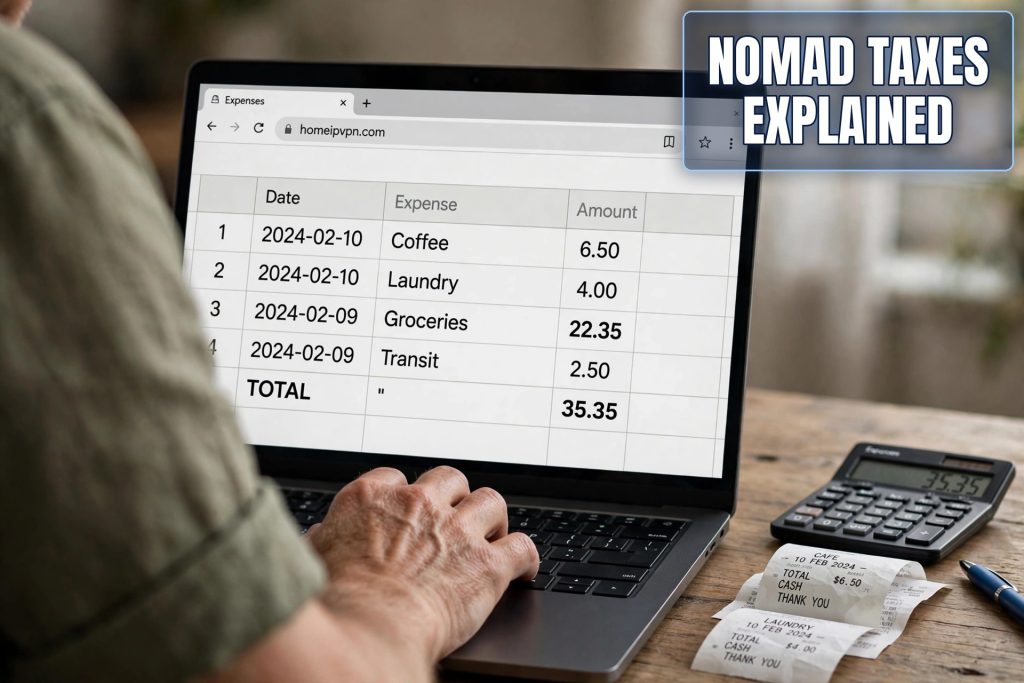
A friend of mine got the letter in Bali. Not an email, a physical letter, forwarded through three addresses, informing him that a tax authority believed he owed them money for a year he had spent mostly on another continent. He had done nothing shady. He had simply moved around a lot, earned money online, and assumed that because he was not really living anywhere, he did not owe taxes anywhere. Tax authorities do not share that assumption.
Taxes are the least fun topic in nomad life and one of the most important. This is not tax advice, I am not an accountant, and nothing here replaces one. What follows is the plain-language map of the questions everyone asks, so you can have an intelligent conversation with a professional instead of starting from zero.
The myth: “I do not live anywhere, so I do not pay taxes anywhere”
This is the single most expensive misconception in the nomad world. Almost every tax system on earth is designed to catch you in one of two nets: citizenship or residency. The United States uses citizenship, which means American nomads file US tax returns on their worldwide income every single year, no matter where they live, how long they have been gone, or whether they set foot in the country. There is no “I moved away” checkbox that ends this.
Most other countries use residency instead. The UK, Canada, Australia, Germany, and the rest generally tax you if you are considered their resident, and stop (mostly) when you genuinely cease to be one. But “genuinely ceasing” has a specific legal meaning involving ties like property, family, bank accounts, and time spent, not just a feeling of having left. Simply traveling does not automatically end your tax residency anywhere.
The uncomfortable result: it is entirely possible to owe taxes in two places at once, or to owe in one place while being chased by another that disagrees about where you live. This is normal for nomads, it is solvable, and it is exactly why this topic deserves professional help rather than forum wisdom.
How countries decide you are “theirs”
Every country has its own test, but most revolve around the same ingredients. Time is the big one: the famous 183-day rule appears in tax treaties and domestic laws all over the world. Spend more than about half the year in a country and many systems will consider you a tax resident there, with filing obligations to match.
But time is not the only ingredient. Authorities also look at ties: Do you have a home available to you there? A spouse or kids? A local bank account, a driver’s license, a gym membership? The more ties, the stronger the claim. Some countries apply a “center of vital interests” test, which is as vague as it sounds and basically asks where your life really is.
For nomads, this creates a strange situation. You might spend 100 days in each of three countries and be under every 183-day threshold, yet still be claimed as a resident by your home country because you never properly severed ties. Or you might accidentally become a tax resident somewhere by staying a few weeks too long. Counting days is not paranoia; it is basic hygiene for this lifestyle. Keep a simple log: country, entry date, exit date. Your future accountant will thank you.
The American special case
US citizens get an extra layer. Beyond the annual filing requirement, there is the Foreign Earned Income Exclusion, which lets qualifying Americans exclude a chunk of foreign-earned income from US tax. Qualifying usually means passing either the physical presence test (330 full days outside the US in a 12-month period) or the bona fide residence test (being a genuine resident of another country). The exclusion has a cap, it does not cover all income types, and you still have to file to claim it.
There is also FBAR and FATCA, the foreign account reporting rules. If your foreign bank accounts total more than ten thousand dollars at any point in the year, you file an FBAR. FATCA adds more reporting thresholds for foreign assets. The penalties for ignoring these are famously severe, wildly disproportionate to the actual tax involved, which is why every US nomad guide screams about them.
Self-employed Americans abroad also face the self-employment tax question. The Foreign Earned Income Exclusion does not exempt you from Social Security and Medicare taxes on freelance income, unless a totalization agreement with your country of residence says otherwise. This surprises a lot of freelancers who assumed the exclusion covered everything.
What freelancers and remote employees each face
How you earn shapes what you owe. Freelancers and business owners generally deal with self-employment or corporate tax rules, which vary enormously. Some nomads incorporate in business-friendly jurisdictions; others operate as sole proprietors under their home country’s rules. Each structure has tradeoffs involving tax rates, paperwork, banking, and credibility with clients. There is no universally right answer, only answers that fit specific situations.
Remote employees have a different puzzle. If you work for a company in one country while sitting in another, questions arise about where your employment is taxed and whether your employer has created a taxable presence, a “permanent establishment,” in your country of residence. Many employers handle this through employer-of-record services; some simply forbid working from certain countries. If your employer does not know you are abroad, that is a conversation worth having before a tax authority has it with you.
Digital nomad visas add another wrinkle. Several countries now offer them, and the tax treatment varies: some offer genuine tax incentives for the first years, others are essentially just long-stay tourist permits with no tax clarity at all. A visa labeled “digital nomad” does not automatically answer any tax question. Read the actual terms.
Double taxation treaties: the safety net with holes
Most pairs of countries have tax treaties designed to prevent the same income being taxed twice. In practice, they usually work through credits (you pay in one country and credit that against what you owe in the other) or exemptions. They help enormously, but they are not magic.
Treaties do not eliminate filing obligations; they mostly affect how much you ultimately pay. You often still have to file in both places to claim the treaty benefits. And treaties have tie-breaker rules for people claimed as residents by two countries, which consider permanent home, center of interests, habitual presence, and finally citizenship, in that order. Knowing which tie-breaker applies to you is precisely the kind of thing worth paying a professional to determine.
Records: the boring superpower
If there is one habit that separates nomads who survive tax season from those who dread it, it is record-keeping. Keep every entry and exit stamp or its digital equivalent. Save flight and accommodation receipts. Maintain that simple country-by-country day log. Keep invoices, contracts, and bank statements organized by year.
Residency disputes are won and lost on evidence. “I was barely there” is an argument; a stamped passport, boarding passes, and a dated log are proof. Digital records are fine, but keep them backed up somewhere other than the laptop that might get stolen in Barcelona.
There is also the practical side of actually filing. Revenue agency portals, e-filing systems, and even some banks’ tax document centers are built for domestic users and frequently misbehave on foreign connections: logins flagged, sessions dropped, documents that will not download. Nomads routinely do their tax admin over a home IP address from a service like HomeIPVPN, so the portal sees a normal domestic session. When you are already stressed about a filing deadline, the last thing you need is the website fighting you too.
When to get professional help (spoiler: early)
The honest answer is that most nomads benefit from professional advice before they leave, not after the first confusing tax year. A good expat tax advisor will map your citizenship, your ties, your income type, and your travel plans onto actual obligations, and the cost is small compared to the penalties for getting it wrong.
Look for advisors who specialize in your home country’s expat rules specifically, not generalists. Ask other nomads for referrals, check that they understand remote income, and be wary of anyone selling a one-size-fits-all offshore structure. The right structure for a freelance designer and a SaaS founder are completely different animals.
And keep the relationship ongoing. Tax rules change, your travel patterns change, and a quick annual check-in is far cheaper than untangling three years of assumptions. Think of it as insurance: boring, slightly expensive, and invaluable the one time it matters.
The bigger picture
At its core, the nomad tax puzzle is a mismatch problem. You live a borderless life, but every tax system, every filing portal, every verification check was built for someone with one address and one country. That same mismatch is the problem HomeIPVPN was built to solve on the connectivity side, giving your devices a home IP address so the home-country services you depend on keep working smoothly wherever you are. If you would rather have someone set that up and verify it works, the Pre-Travel Audit & Advisory session is 1 hour, costs $79, and that fee comes straight off the $279 Secure Home IP VPN System session if you go ahead.
None of this is advice, and your situation has details no article can cover. Count your days, keep your receipts, talk to a professional early, and do not let the boring stuff become the expensive stuff.