REMOTE WORK & DIGITAL NOMAD
Istanbul for Remote Workers: The Europe-Asia Bridge Base
The ferry was crossing the Bosphorus at sunset when Istanbul sold me. On the left, the mosques and palaces of the old city glowed gold. On the right, the glass
✓Internet: the foundation is solid✓Where to base: the European side✓Costs: the math that makes it work
Quick Answer
Istanbul is one of the most practical nomad bases for 2026: fast fiber internet in most neighborhoods, living costs well below Western Europe, and a time zone that overlaps with both Europe and Asia workdays. The city straddles two continents, so you get European infrastructure with Middle Eastern prices. Most remote workers base on the European side in areas like Kadikoy, Besiktas, or Beyoglu for the best mix of coworking, cafes, and transport.
- Internet is genuinely good: fiber connections of 100 Mbps or more are standard in central neighborhoods, and coworking spaces offer reliable backup for important calls.
- Costs stay reasonable: a comfortable nomad month runs far below London or Berlin prices, with good apartments, cheap transport, and excellent food.
- Time zone is a superpower: Istanbul sits between Europe and Asia, so you can cover European mornings and Asian afternoons in one workday.
- Keep your accounts calm while you settle in: Turkish IPs trigger login alerts on foreign banks, so route your work through HomeIPVPN and every account will see your familiar home connection instead.
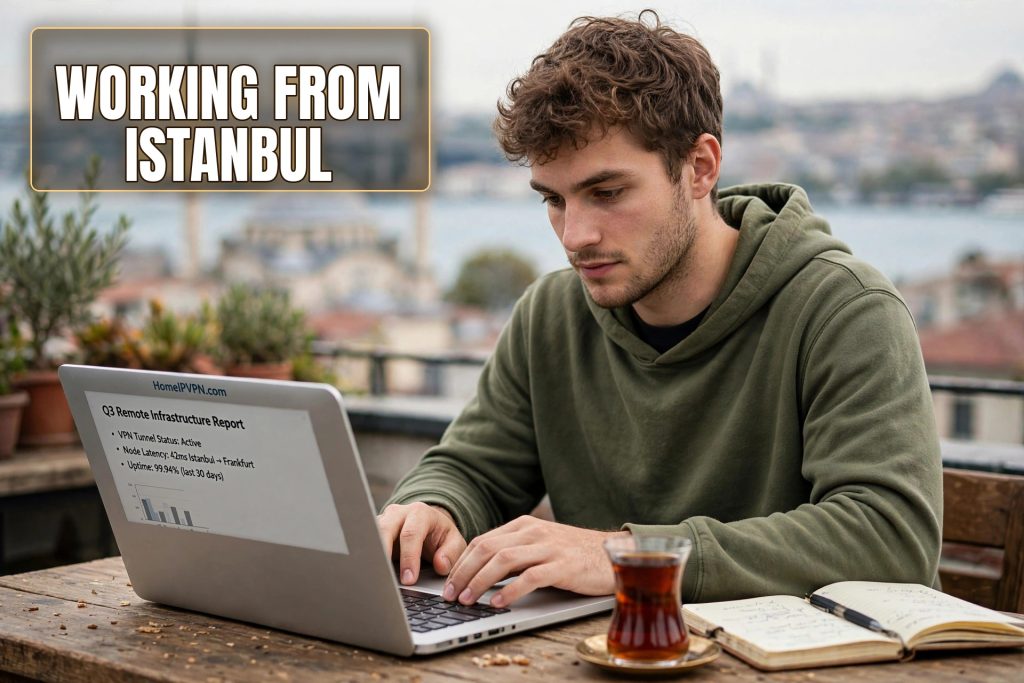
The ferry was crossing the Bosphorus at sunset when Istanbul sold me. On the left, the mosques and palaces of the old city glowed gold. On the right, the glass towers of the business district lit up. My laptop was open on my knees, I was finishing a work call over the ferry WiFi, and it struck me that this city lets you work a European schedule, eat like you are in the Middle East, and pay Southeast Asian prices, all in the same day.
Istanbul keeps showing up on 2026 top-ten lists for digital nomads, and for once the hype is mostly accurate. This is not a beach town with good marketing. It is a fifteen-million-person megacity with real infrastructure, and it happens to be affordable, fascinating, and extremely well positioned for remote work. Here is the practical picture.
Internet: the foundation is solid
Let us start with what matters most. Istanbul has genuinely good internet. Fiber connections are standard in central neighborhoods on both the European and Asian sides, and 100 Mbps down is unremarkable. Many apartments come with fiber already installed, and getting it set up in a new rental is a routine errand, not a project.
Mobile data is cheap and fast, which matters because it is your backup. A local SIM with a generous data plan costs a few dollars a month, and 4G coverage is excellent across the city, including on the ferries and in the metro. I have taken video calls from a moving ferry using a phone hotspot and had nobody notice. That is the kind of backup that turns an outage from a crisis into a shrug.
Coworking spaces are plentiful and good. The European side has the highest concentration, in areas like Levent, Maslak, Beyoglu, and Kadikoy. Expect proper desks, fast wired options, meeting rooms, and phone booths. Prices are reasonable by global standards, and most spaces offer day passes so you can test before committing to a month. The quality bar is high because the market is competitive.
Cafe WiFi is a mixed bag, as it is everywhere. The third-wave coffee shops in Kadikoy and Cihangir generally have solid connections and do not mind laptop workers. Traditional tea houses are for tea, not work. Learn the difference quickly and you will be fine.
Where to base: the European side wins for most
Istanbul is two cities connected by bridges, and where you live shapes your experience. For most remote workers, the European side is the better base. It has more coworking spaces, better transport links to the airport, and the neighborhoods with the strongest nomad and expat communities.
Kadikoy, technically on the Asian side but connected by a twenty-minute ferry, is the favorite among long-stay nomads. It has the best cafe culture in the city, a young local crowd, excellent food, and a relaxed vibe that feels more neighborhood than megacity. The ferry commute to the European side is genuinely pleasant, and many people treat it as a feature, not a cost.
Besiktas and the surrounding Bosphorus neighborhoods are the upscale option: beautiful streets, great restaurants, and quick access to the business districts. Beyoglu, including Cihangir and Galata, is the classic choice for first-timers, central, walkable, full of character, though noisier and more touristy. Each has a different personality, so spend your first week sampling before signing a monthly rental.
Rents are the good news. A comfortable one-bedroom in a central neighborhood costs a fraction of what you would pay in any Western European capital. Monthly rentals aimed at nomads and expats are common, and the usual platforms plus local Facebook groups will get you sorted. Always visit before paying, and always test the internet in the actual apartment before signing anything.
Costs: the math that makes it work
Istanbul is one of the few major world cities where a nomad can live well on a moderate income. A comfortable month, decent apartment, coworking membership, eating out regularly, using transport daily, runs well below what the same lifestyle costs in Lisbon, let alone London or Amsterdam.
Food is the standout bargain. This is a city where an incredible lunch costs a few dollars and a great dinner does not require planning. The street food alone, simit, balik ekmek, kokorec for the brave, could sustain you for weeks. Groceries from local markets are cheap and excellent. You will eat better here for less money than almost anywhere else on the nomad circuit.
Transport is cheap and the system actually works. The metro, trams, ferries, and buses are integrated on a single card, and a month of heavy use costs very little. The ferries deserve special mention: they are public transport and a tourist attraction at the same time, and a cross-continent commute with a sea view never gets old.
The one cost to watch is anything priced for tourists or expats in dollars or euros. Some landlords quote in foreign currency, and some services have a visible two-tier price. Learning a little Turkish and shopping where locals shop keeps your costs at local levels.
The time zone advantage
Istanbul sits at UTC+3 year round, no daylight saving changes, and this is quietly one of its biggest selling points. You overlap with all of Europe for the full workday, you catch the Middle East and much of Asia in the afternoon, and you can reach the US East Coast in your late afternoon and evening.
For nomads working with European clients or employers, it is perfect: same working hours, no 6am calls. For those bridging Europe and Asia, it is one of the only cities where both are practical in a single day. Even US-based workers find it manageable, with a focused evening shift covering the American workday.
The lack of daylight saving changes is a small blessing you will appreciate twice a year when everyone else schedule shifts and yours does not.
Visas and the practical paperwork
Many nationalities get a generous visa-free stay or an easy e-visa on arrival, often ninety days. That covers a solid season without any paperwork. For longer stays, Turkey has a residence permit process that many nomads navigate successfully, though it involves bureaucracy and patience.
Turkey has also discussed a dedicated digital nomad visa, and the details keep evolving. Check the current rules before you plan around any specific visa type, because this landscape changes. The ninety-day visa-free window is the reliable foundation; everything beyond that needs current research.
Banking as a foreigner is doable but requires the residence permit for a local account. Most nomads operate on foreign accounts plus a local SIM and cash for daily life. Card acceptance is widespread in the city, though cash is still king in markets and smaller shops.
Working culture and daily life
Istanbul is a late city. Dinner at nine, cafes full at midnight, and a work culture that does not blink at evening schedules. If you are working US hours, the city will keep you company. If you are an early riser, the mornings are peaceful and the bakeries are already open.
The expat and nomad community is large enough that you will find your people quickly, through coworking spaces, meetups, and the usual online groups. The local population is famously hospitable, and a little Turkish goes a very long way. Learn the basics, accept the tea you are offered, and you will be amazed how fast this city adopts you.
Safety-wise, Istanbul is a big city with big-city rules: normal awareness, no special worry. The tourist areas have the usual pickpocketing, and traffic deserves more caution than crime. Millions of people live and work here safely every day.
One practical warning: your accounts will notice the move
Here is the thing nobody puts in the nomad guides. The moment you start logging into your bank, your email, and your work tools from a Turkish IP address, the fraud systems notice. New country, new network, new pattern. Expect verification challenges, temporary locks, and “was this you” emails in your first weeks.
This is not a reason to avoid Istanbul. It is a reason to prepare. I route my logins through HomeIPVPN, so my bank and my work tools see my home connection, the same one they have seen for years. No alerts, no frozen accounts in the middle of settling into a new city. It is the kind of boring infrastructure that makes the exciting parts of nomad life possible.
The root cause, and a simpler fix
The hidden tax on every move abroad has a simple root cause: your digital life is anchored to your home country, and every new IP address makes your accounts suspicious. Istanbul is worth the move for a hundred reasons, but the login chaos in week one is not one of them.
That exact problem is what HomeIPVPN was built to solve. Your home connection travels with you to every new city, so your accounts never see a move at all. If you would rather have someone set it up for you and verify it works, the Pre-Travel Audit & Advisory session is 1 hour, costs $79, and that fee comes straight off the $279 Secure Home IP VPN System session if you go ahead.
Istanbul rewards the nomads who settle in properly. Get the apartment with real fiber, find your Kadikoy cafe, learn to love the ferry, and let the city do the rest.