REMOTE WORK & DIGITAL NOMAD
Working From the Greek Islands: Internet Reality Beyond Athens
The ferry pulls into the harbor just after seven in the morning. The town is still half asleep, cats stretching on warm stone, a bakery already sending the…
✓The islands are not one internet✓Where remote work actually works:✓The islands to approach with a
Quick Answer
Internet on the Greek islands is a tale of two realities: Crete, Rhodes, and Corfu have solid fiber and 4G/5G in their main towns, while smaller islands can be slow, patchy, or seasonal. For video calls and deadlines, base yourself in a main town, test the actual connection before committing to a rental, and always carry a mobile data backup.
- Best bets: Crete (Heraklion, Chania), Rhodes Town, and Corfu Town have the most reliable connections for remote work.
- Test first: Ask landlords for a live speed test screenshot and confirm whether the building has fiber, not just “fast WiFi”.
- Backup plan: A local SIM with a generous data plan is cheap insurance when the rental WiFi dips during a call.
- Banking from the islands: Island IPs can look unusual to your home bank’s fraud system, so many nomads keep their connection anchored through HomeIPVPN and avoid the account-lock dance entirely.
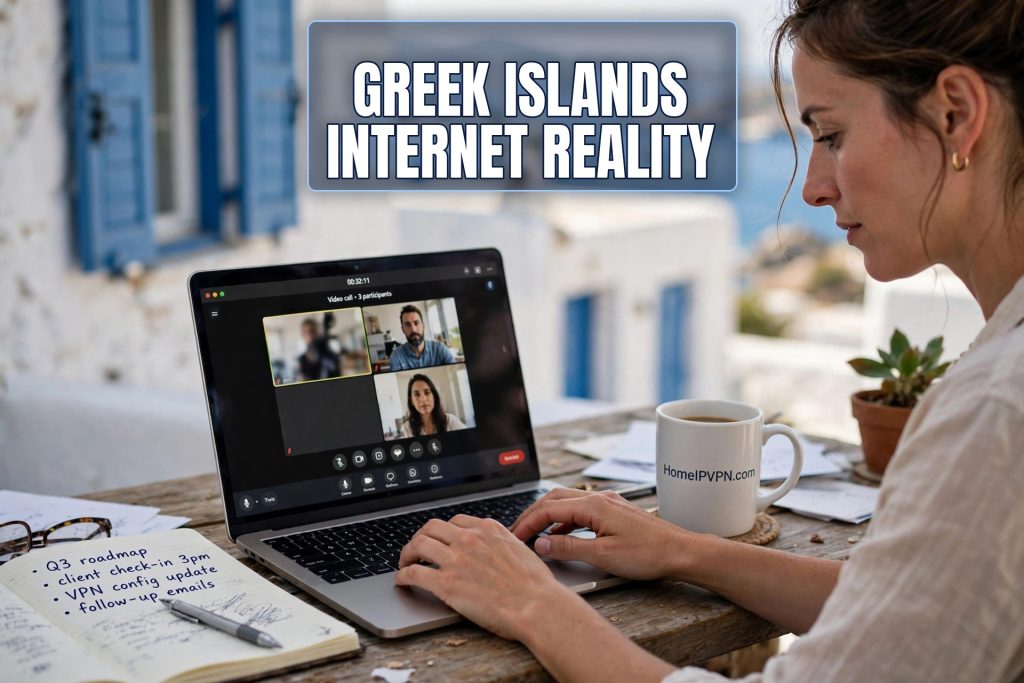
The ferry pulls into the harbor just after seven in the morning. The town is still half asleep, cats stretching on warm stone, a bakery already sending the smell of fresh spanakopita down the alley. You find a table at a cafe on the waterfront, open your laptop, and the WiFi connects instantly. Speed test: 80 megabits down. You grin. This is going to work.
Three weeks later you are on a smaller island, forty minutes by boat from anywhere with a hospital, and the same laptop is tethered to your phone at the edge of a taverna terrace while your video call freezes on your own face mid sentence. Both of these are the Greek islands. The distance between them is the difference between checking the internet situation before you book and assuming an island is an island.
This is the honest guide to working from the Greek islands: where the connection holds up, where it falls apart, and how to set yourself up so your work survives the geography.
The islands are not one internet market
The first thing to internalize is that “Greek islands internet” is not a single thing. Crete is basically a small country, with cities, universities, and infrastructure to match. Rhodes and Corfu have real towns with real fiber. Then there is a long tail of smaller islands where the population drops to a few hundred in winter, the single telecom mast serves everyone, and the cafe WiFi is a router the owner rebooted in 2019 and never touched again.
The pattern is simple: the bigger the year round population, the better the connectivity. Tourist volume matters less than resident volume, because infrastructure gets built for people who live somewhere in February, not people who visit in August. When you are choosing an island, look at the winter population, not the summer Instagram posts. A town of twenty thousand permanent residents will have fiber, multiple mobile carriers with strong signal, and a coworking space. A village of four hundred will have one mast and a prayer.
This is not a knock on small islands. They are beautiful, and for a week of writing with no calls, they are paradise. But if your job involves daily video meetings, client deadlines, and large file uploads, the romance of remoteness has a price, and the price is paid in frozen Zoom windows.
Where remote work actually works: the reliable islands
Crete is the safest choice and it is not close. Heraklion and Chania both have fiber widely available, coworking spaces with proper backup connections, and mobile data so cheap you will wonder why you ever paid home prices. Rethymno is smaller but perfectly workable. You can run a full remote job from Crete indefinitely, and thousands of people do.
Rhodes Town is the second strong pick. The old town is gorgeous, the new town has the infrastructure, and the island’s size means you are never far from a solid connection. Corfu Town rounds out the top three: good fiber in the center, a growing nomad community, and easy access to the mainland if you ever need it. These three are the “just book it” islands for remote workers.
A step below but still viable: Syros, with Ermoupoli as a genuinely functional small city; Naxos Town, which has improved enormously in recent years; Paros, particularly Naoussa and Parikia; and Santorini, where Fira and the main towns have good connections even though prices will make your eyes water. Santorini works fine technically. It just charges you a premium for the privilege of a caldera view while you answer emails.
The islands to approach with a plan, not a hope
Smaller Cyclades islands like Koufonisia, Schinoussa, and Donoussa are stunning and, for most remote workers, a gamble. The connections exist but they are shared, seasonal, and vulnerable to a single point of failure. If a storm takes out the mast, you are offline until someone fixes it, and “someone” may be on another island. Visit for a long weekend. Do not sign a month lease counting on daily standups.
The Dodecanese beyond Rhodes follows the same logic. Kos Town is fine. Tiny islands like Tilos or Nisyros are for disconnecting, which is a legitimate vacation goal and a terrible work plan. The Sporades, Skiathos and Skopelos, sit in the middle: workable in the main towns during season, quieter and spottier off season. The Ionian islands beyond Corfu, Kefalonia and Zakynthos, have decent main towns but thin coverage the moment you leave them.
The seasonal factor cuts both ways. In August, the networks on popular islands are saturated with tourists streaming video at the beach, and your speeds can halve compared to May. In winter, some islands effectively shut down: cafes close, coworking spaces go dark, and the social life that makes nomad life bearable evaporates. Shoulder seasons, late spring and early autumn, are the sweet spot for both connectivity and quality of life.
How to vet a rental’s internet before you commit
This is the most valuable skill in this entire guide, so let us be specific. When you message a landlord or Airbnb host, do not ask “is the WiFi good?” Everyone says yes. Instead, ask these four questions. One: is the connection fiber to the building, and what speed does the contract say? Two: can you send me a screenshot of a speed test run right now, from inside the apartment? Three: is the router in the apartment itself or shared with other units? Four: what is the mobile signal like inside, and which carrier works best?
A host who answers all four promptly is a host who has nothing to hide. A host who replies “very fast internet!!!” and nothing else is telling you everything you need to know. For monthly rentals, this vetting is worth more than the photos of the terrace. You will spend eight hours a day on that connection. The terrace gets twenty minutes.
If you are staying longer than a month, consider getting your own mobile data setup as the primary backup. Greek prepaid SIMs with large data allowances are inexpensive, and a portable hotspot device means you are never dependent on a single cafe router. Many nomads work this way permanently: rental WiFi as the default, phone hotspot as the instant failover when a call matters. It is the cheapest business continuity plan you will ever buy.
Coworking spaces and the cafe question
Crete, Rhodes, and Corfu all have coworking spaces now, and they solve two problems at once: guaranteed fast internet and other humans. The good ones have backup connections, proper monitors for rent, and phone booths for calls. If your work is call heavy, a coworking membership for your first month on any island is money well spent while you figure out the local landscape.
Cafes are the romantic option and the risky one. Greek cafe culture is wonderful for slow work, writing, and admin, but terrible for anything where a dropped connection costs you money. The etiquette is also real: buy something every couple of hours, do not take calls on speaker, and do not camp a four top during the lunch rush. The islands run on tourism and hospitality, and the fastest way to wear out your welcome is to treat a family taverna like your personal office.
A practical middle ground that many island nomads settle into: coworking or home fiber for calls and deep work, cafes for the afternoons when the light is golden and the tasks are light. Your calendar, not your wanderlust, should decide which one you are sitting in.
Banking, logins, and the IP address problem
Here is something the travel blogs skip. Your bank, your employer’s systems, and half your online accounts pay attention to where you log in from. A connection from a small Greek island, possibly routing through an IP address your bank has never seen, looks exactly like the kind of thing fraud departments are paid to worry about. Locked accounts and blocked transfers are the classic island arrival story, usually on day two, usually when you need to pay the rental deposit.
The fix that actually holds up is to stop looking like you moved. A home IP setup keeps your traffic exiting through your own residential connection back home, so every login looks like it is coming from your couch, not a beach bar in Paros. That is what HomeIPVPN builds for remote workers: one stable home IP address that follows you from island to island, so your bank sees nothing to panic about. It is the kind of thing you set up once and then forget about until you realize you have not thought about your bank in months, which is exactly the point.
Picking your island: a decision framework
Stop choosing by photographs and start choosing by constraints. First constraint: your call load. Daily video calls mean Crete, Rhodes, or Corfu, full stop. Async work with occasional calls opens up the mid tier islands. Pure writing or coding with no calls means anywhere with a pulse.
Second constraint: season. Summer means crowds and saturated networks on the famous islands, but everything is open. Winter means empty streets, closed businesses, and the real local life, but only the bigger islands stay functional. Shoulder season is the cheat code.
Third constraint: your tolerance for logistics. Bigger islands have pharmacies, clinics, hardware stores, and ferry connections when something breaks. Smaller islands have a single minimarket and a boat schedule that the wind can cancel. Both are fine. Only one of them is fine when your laptop charger dies on a Sunday.
Get these three right and the Greek islands will give you some of the best working months of your life. Get them wrong and you will be that person angrily tethering at a taverna, and nobody wants to be that person.
The thread running through all of this is that remote work from the islands fails or succeeds on infrastructure you cannot see in photos: the fiber line, the mast on the hill, the IP address your bank sees when you log in. That last one is the easiest to fix permanently, and it is the reason HomeIPVPN exists: a home IP travels with you while island networks do not. If you would rather have someone set it up and verify it works before you board the ferry, the Pre-Travel Audit & Advisory session is 1 hour, costs $79, and that fee comes straight off the $279 Secure Home IP VPN System session if you go ahead.
Pick the big island first. Fall in love with the small one later, on vacation, with your out of office on.