REMOTE WORK & DIGITAL NOMAD
Power Outlets Abroad: The Adapter Mess, Simplified
I learned about voltage the expensive way, in a bathroom in Buenos Aires. My hair dryer, a perfectly good one from home, made a sound like a dying robot for…
✓Problem one: the shape of the plug✓Problem two: the voltage behind✓The simple system that covers
Quick Answer
One universal travel adapter plus a compact multi-port USB charger covers nearly every country. Check whether your devices need voltage conversion (most modern chargers handle it automatically), and never plug a high-heat device like a hair dryer into a simple adapter.
- Adapter changes the shape, not the power: it lets your plug fit the wall, but it does not convert voltage; your charger does that, if it is rated for it.
- Check the fine print on your charger: a label reading “100-240V” means it works worldwide; anything narrower needs a real voltage converter.
- Heat devices are the danger zone: hair dryers, straighteners, and kettles draw huge power and can melt adapters or trip breakers abroad.
- Keep your digital life consistent too: just as one adapter standardizes your power everywhere, HomeIPVPN standardizes your internet connection to look like home in every country.
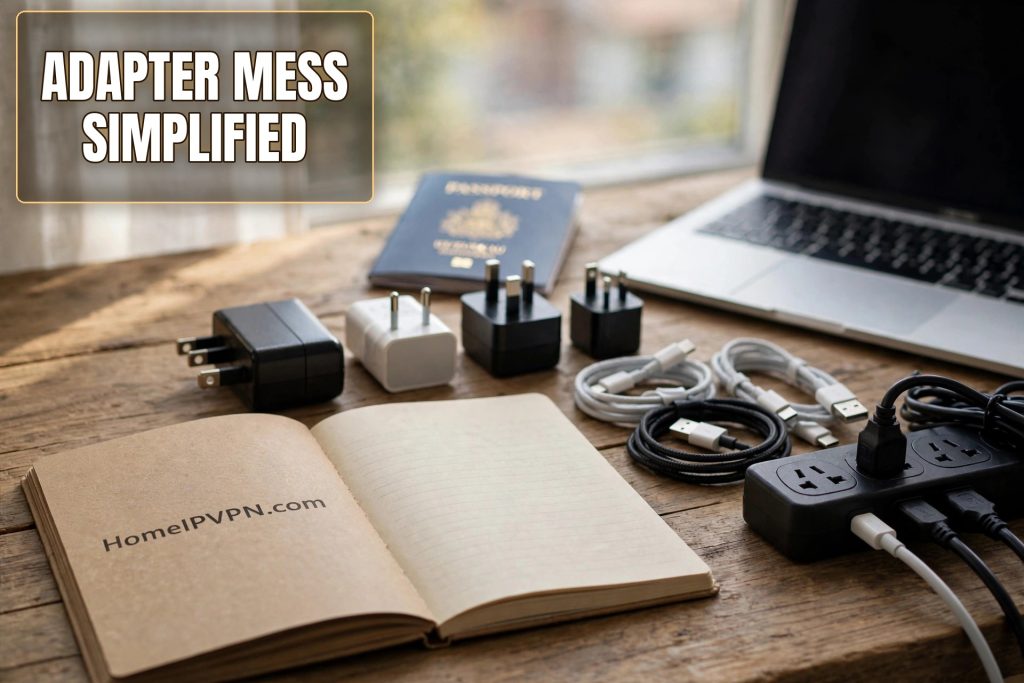
I learned about voltage the expensive way, in a bathroom in Buenos Aires. My hair dryer, a perfectly good one from home, made a sound like a dying robot for about four seconds, produced a smell I can only describe as electrical regret, and never worked again. The adapter had fit the wall socket beautifully. The adapter had done its one job. Nobody had told me the wall was delivering twice the voltage my dryer expected, and the dryer had opinions about that.
Power abroad confuses everyone at first because it is actually two separate problems wearing one disguise: the shape of the plug, and the electricity behind it. Once you separate them, the whole mess becomes a simple system. Here it is.
Problem one: the shape of the plug
The world uses more than a dozen plug shapes, which is absurd but true. The UK has its chunky three-pin. Europe mostly uses two round pins. Australia has angled flat pins. Switzerland has its own special version because of course it does. Your charger from home physically will not fit most foreign sockets, and no amount of wishing changes that.
The fix is a universal travel adapter: a single brick with sliding pins that reconfigures into the common shapes. A decent one costs twenty to thirty dollars, weighs almost nothing, and ends the era of buying a new adapter in every airport. Get one with a few built-in USB ports, because that turns one wall socket into a charging station for your phone, earbuds, and watch simultaneously.
One caution: cheap no-name adapters from market stalls can have loose pins that arc and overheat. This is one of the few travel items where the reputable brand is worth the extra ten dollars. You are plugging expensive electronics into foreign wiring through this thing; it should feel solid, click firmly into each configuration, and carry a real safety certification mark.
Problem two: the voltage behind the socket
Here is the part that killed my hair dryer. Much of the world runs on 220 to 240 volts. North America, Japan, and a few others run on 100 to 127 volts. Plug a single-voltage 120V device into a 230V socket and it receives roughly double the electricity it was designed for, which ends exactly as dramatically as you would expect.
Now the good news, and it is genuinely good: almost every modern charger already handles this. Look at the tiny print on your laptop brick, phone charger, or camera charger. If it says “Input: 100-240V,” it is a dual-voltage device that works anywhere on earth. You only need the shape adapter; the charger sorts out the voltage by itself. Nearly all laptops, phones, tablets, Kindles, and camera battery chargers made in the last decade are dual-voltage.
The devices that are not: anything that makes heat. Hair dryers, straighteners, curling irons, travel kettles, and clothes irons are often single-voltage, because heating elements are cheap to make for one voltage and expensive to make for two. These are the devices that die, melt, or start small fires abroad. Either buy a dual-voltage travel version, buy a proper voltage converter rated for the wattage, or do what most long-term nomads do and stop traveling with heat devices entirely. Every Airbnb has a hair dryer. Let it go.
The simple system that covers everything
Here is the whole kit, and it fits in a pouch smaller than a paperback. One quality universal adapter with USB ports. One compact multi-port USB charger, the gallium nitride kind, which can fast-charge a laptop, phone, and earbuds from a single plug. Your device chargers, all checked for the magic 100-240V label. Short cables, because long ones tangle into a nest within days.
The multi-port charger deserves emphasis because it changes the game. Instead of one adapter per device, you plug the charger into the adapter once, and everything charges from the charger. One wall socket, four devices, zero cable spaghetti. Modern GaN chargers the size of a matchbox can output enough power for a laptop plus a phone at full speed. This is the single best hundred-gram upgrade to any travel kit.
Leave the power strip at home. Daisy-chaining strips into adapters into foreign sockets is how you discover the fire rating of an Airbnb the hard way. One adapter, one charger, done.
Reading the label: a thirty-second skill
Before any trip, spend five minutes checking every device you plan to bring. Flip each charger over and find the input line. “100-240V, 50/60Hz” means worldwide, no worries. A single number like “120V” means it stays home or needs a converter. The 50/60Hz part refers to the current’s frequency; virtually all modern electronics ignore the difference, so only the voltage number matters.
Pay special attention to anything with a motor or heating element, anything cheap and obscure, and anything borrowed. Electric toothbrushes are usually fine. LED desk lamps are usually fine. That novelty mug warmer from a conference swag bag is not worth the risk. When in doubt, search the model number plus “dual voltage” before you pack it.
USB-powered everything is the nomad cheat code. A device that charges over USB-C sidesteps the voltage question entirely, because the charger handles it. When choosing between two versions of a gadget, pick the USB-C one. Your future self, staring at a wall of unfamiliar sockets, will approve.
Country quirks worth knowing
A few places have extra personality. The UK, Ireland, and much of the Gulf use high-power 230V with big fused plugs; your adapter handles the shape, your dual-voltage gear handles the rest. Japan runs on 100V, lower than anywhere else; American 120V devices usually survive it, but may run slightly underpowered, while 230V-only devices will barely function.
Some countries have unreliable power: voltage spikes, brownouts, sudden outages. If you work somewhere with flaky electricity, a small surge protector between the wall and your gear is cheap insurance for a two-thousand-dollar laptop. Unplug during electrical storms regardless; no adapter protects against lightning.
Bathroom sockets deserve a mention. Many countries have special shaver sockets in bathrooms with an isolation transformer, usually labeled 110/220V. They are low-power by design and will not run a hair dryer, but they are perfect for an electric toothbrush. Do not force high-draw devices into them.
Charging strategy for work days
Remote work adds one more consideration: you cannot afford a dead laptop at 3 p.m. Build a charging routine. Charge everything overnight from your one adapter station. Keep a small power bank in your day bag for cafes with no free sockets, which is more cafes than you would hope. Know your laptop’s real battery life under work conditions, not the manufacturer’s fantasy number, and plan your cafe sessions around it.
Coworking spaces are the reliable fallback: abundant sockets, stable power, and nobody glaring at you for occupying the one outlet. If your work depends on being online all day, the cost of a coworking desk is trivial compared to a missed deadline because your battery died in a beautiful but socket-free old town.
And just as you standardize your power with one adapter system, it pays to standardize your connection. Foreign networks are as varied as foreign sockets: captive portals, throttled speeds, blocked services. A home IP address from a service like HomeIPVPN gives you the same familiar, trusted connection in every country, the way your universal adapter gives you the same plug everywhere. One less foreign system to fight per day.
The bigger picture
The underlying annoyance here is that every country built its own infrastructure and none of them asked about you. Different plugs, different voltages, different networks, different rules, and you are expected to adapt weekly. The adapter solves the physical half of that problem. A home IP address solves the digital half, which is the problem HomeIPVPN was built for: your devices keep a home connection identity no matter which country’s sockets and networks surround you. If you would rather have someone set that up and verify it works, the Pre-Travel Audit & Advisory session is 1 hour, costs $79, and that fee comes straight off the $279 Secure Home IP VPN System session if you go ahead.
Check the labels, pack the one good adapter, leave the hair dryer at home. Your electronics will survive the trip, and so will you.