REMOTE WORK & DIGITAL NOMAD
Residency vs. Citizenship vs. Tax Residency: What Nomads Actually Mean
I was sitting in a coworking space in Mexico City when someone at the next desk asked the question I had been avoiding for a year: “So where are you a…
✓Residency: permission to be✓Citizenship: the country you✓Tax residency: where the money is
Quick Answer
Residency is where you are allowed to live, citizenship is the country you belong to, and tax residency is where you owe taxes. A nomad can easily hold one citizenship, hold residency in a second country, and owe taxes in a third, because each status is decided by different rules.
- Residency is permission to live somewhere: visas and permits decide where you may stay and for how long, and they say nothing about taxes on their own.
- Citizenship is membership: it gives you a passport and usually the right to live in that country forever, and for Americans it also means worldwide taxation.
- Tax residency is about money: it is decided by days spent, homes, and ties, and it is entirely possible to be a tax resident somewhere you are not a citizen.
- All three assume you stay put: every government portal behind these statuses expects a domestic connection, which is why nomads manage the paperwork through a home IP address from HomeIPVPN.
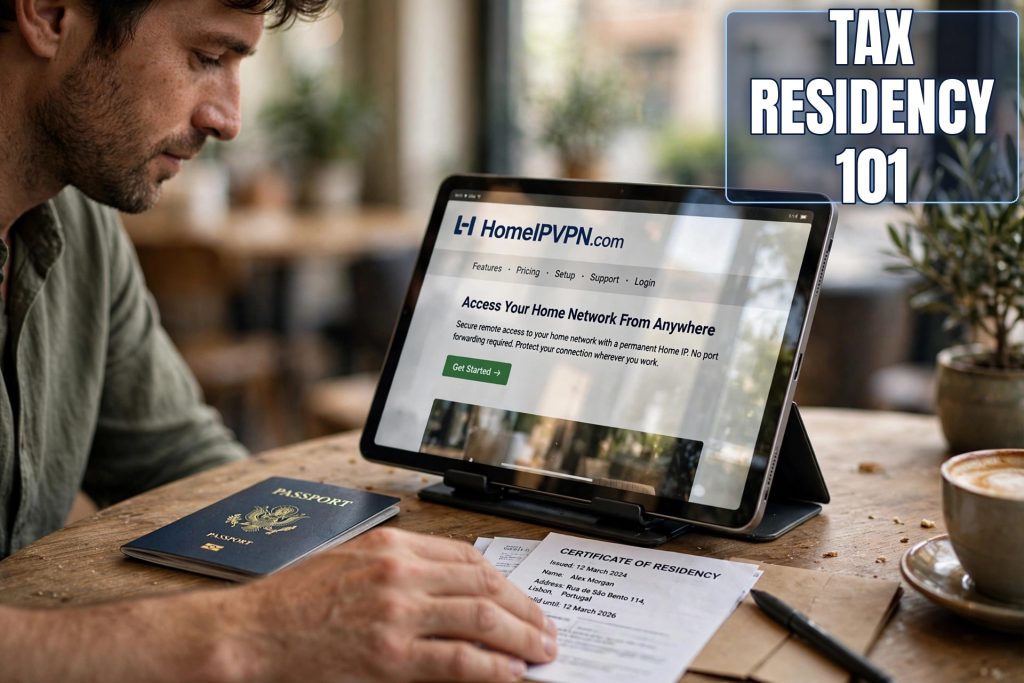
I was sitting in a coworking space in Mexico City when someone at the next desk asked the question I had been avoiding for a year: “So where are you a tax resident?” I opened my mouth, closed it, and said something vague about it being complicated. He laughed and said, “That is what everyone says right before they get the letter.” Then he asked where I was a legal resident, and I realized I was not sure about that one either. Citizenship I knew. The other two were fog.
These three words get tossed around in nomad conversations like everyone agrees on what they mean. They do not, and the confusion is not just academic. Each one controls something different: where you may live, which passport you carry, and who gets a cut of your income. Let us untangle them properly, in everyday language.
Residency: permission to be somewhere
Residency, in the everyday sense, is simply a government’s permission for you to live in its country. A tourist stamp gives you short-term residency. A digital nomad visa gives you longer residency with conditions. Permanent residency lets you stay indefinitely. Each level comes with different rights: the right to rent long-term, open bank accounts, access healthcare, and sometimes work.
The crucial thing people miss: residency permission says nothing about taxes by itself. You can be a legal resident of Portugal on a nomad visa and still not be a Portuguese tax resident, depending on the visa terms and how the days fall. Conversely, you can owe taxes in a country where you hold no residency permit at all, if you spent enough time there. The visa office and the tax office are different buildings with different rulebooks.
Residency also comes in flavors that matter. Being a resident for immigration purposes (you may live here) is not the same as being domiciled (this is your permanent home in the eyes of the law) or being ordinarily resident (you live here as a matter of course). Countries like the UK split these hairs with genuine enthusiasm, and the distinctions affect everything from inheritance to which courts handle your affairs.
Citizenship: the country you belong to
Citizenship is membership. It usually gives you a passport, the unconditional right to enter and live in that country, the right to vote, and consular protection abroad. Most people get it by birth, either from being born on a country’s soil or to citizen parents, and some acquire it later through naturalization after years of residence.
For most nationalities, citizenship is relatively quiet in daily nomad life. It determines your passport power, which decides how many borders you cross without a visa, and it is the document you reach for at immigration. It does not, for most of the world, determine your taxes. A French citizen living full-time in Thailand with no French ties generally does not owe France income tax. Citizenship and tax residency are separate questions, and conflating them causes endless confusion.
The giant exception is the United States, plus one other country with similar rules. Americans are taxed on worldwide income based on citizenship alone, forever, until they file and pay and in some cases formally renounce. This is why “I am not American, so the citizenship part does not affect my taxes” is true for almost everyone, and why Americans abroad have an entire extra layer of paperwork that the rest of us do not.
Dual citizenship adds another dimension. Some nomads collect second passports through ancestry, investment, or long residence, which can open visa-free travel and backup options. But each citizenship can carry obligations: military service registration in some countries, tax filing in the American case, and exit taxes if you ever renounce. A second passport is a powerful tool, not a souvenir. Understand what it signs you up for.
Tax residency: where the money is owed
Tax residency is the status that decides which country gets to tax your income, and it is the one nomads get wrong most often. It is not a card you carry or a stamp in your passport. It is a conclusion a tax authority reaches about you, based on its own tests, and different countries can reach different conclusions about the same person simultaneously.
The tests usually combine time and ties. Time is the famous 183-day threshold: spend more than half the year in a country and many systems will call you their tax resident. Ties include having a home available, a spouse or family there, local bank accounts, business interests, and even things like club memberships. The more ties, the less time it takes to be claimed.
Here is where it gets properly strange. You can be a tax resident of nowhere and everywhere at once. Nowhere, because you never cross any country’s threshold. Everywhere, because two countries both decide your ties point at them. Treaties between countries have tie-breaker rules for exactly this situation, applied in a specific order: permanent home first, then center of vital interests, then habitual presence, then citizenship. But invoking a tie-breaker usually means filing in both places and arguing your case, which is nobody’s idea of fun.
The practical takeaway: tax residency is not something you choose by feeling. It is something you manage with day counts, documented ties, and professional advice. Keep that travel log. Know your numbers. Do not assume.
How the three interact in real nomad lives
Let us make this concrete with three sketches. First, the classic: a German citizen on a one-year nomad visa in Mexico, spending eight months there. Citizenship: Germany. Immigration residency: Mexico, temporary. Tax residency: quite possibly still Germany if she kept her apartment and bank ties, or Mexico if she cut ties and crossed the day threshold, or arguably both until a treaty tie-breaker sorts it out. Three statuses, three different answers.
Second, the American in Bali: US citizen, Indonesian temporary stay permit, and tax resident of the United States by citizenship no matter what, plus potentially Indonesia if the days and ties line up. The US layer never goes away. This is why American nomads have the most complex version of this puzzle and the strongest need for specialist advice.
Third, the “perpetual traveler” spending three months in each of four countries: no long-term immigration residency anywhere, citizenship of one country, and tax residency that depends entirely on whether the home country considers the ties severed. Many people in this pattern discover, uncomfortably, that their home country never stopped considering them resident, because they kept the apartment, the driver’s license, and the bank accounts. You cannot be a ghost if you left all the lights on.
Why everyone confuses them (and why it matters)
The confusion persists because in normal settled life, the three usually point at the same country. You are a citizen of France, you reside in France, you pay tax in France. One address, one answer. Nomad life splits them apart, and suddenly you need vocabulary most people never develop.
It matters because each status gates something you need. Immigration residency gates your legal right to be where you are. Citizenship gates your passport, your vote, and your consular protection. Tax residency gates who can demand a share of your income and whose forms you must file. Getting any of them wrong has consequences ranging from visa denial to back taxes with penalties.
The most common real-world mistake is assuming one status settles the others. “I have a nomad visa, so I am sorted for tax” is wrong. “I am not a resident anywhere, so I owe nothing” is wrong. “I pay tax at home, so I can live anywhere” is sometimes wrong. Each question needs its own answer, from its own rulebook, ideally with a professional checking your work.
The paperwork reality
Here is the part nobody romanticizes: each of these statuses lives behind a government portal, and those portals are built for people sitting in that country. Visa applications, tax filings, residency renewals, and citizenship paperwork increasingly happen online, on sites that check your location, demand local phone verification, or simply malfunction on foreign connections.
Nomads learn to do this admin over a connection that looks like it comes from home. A home IP address from a service like HomeIPVPN turns a foreign cafe connection into a domestic session as far as the portal is concerned, which means fewer blocked logins, fewer verification loops, and fewer afternoons lost to a website that will not believe you are who you say you are. When you are dealing with immigration and tax authorities, you want the technology to be invisible.
Keep copies of everything that establishes each status: visa grants, entry stamps, lease agreements, tax filings, and correspondence with authorities. These documents are the evidence that backs up your answers if any status is ever questioned. Store them somewhere safer than a single laptop.
The bigger picture
The reason these three concepts tangle so badly is that every system behind them was designed for people with one home, one address, one country. You have a life spread across borders, and the mismatch between your reality and their assumptions is the problem HomeIPVPN was built to solve on the connectivity side: a home IP address so the home-country services you rely on keep working as if you never left. If you would rather have someone set that up and verify it works, the Pre-Travel Audit & Advisory session is 1 hour, costs $79, and that fee comes straight off the $279 Secure Home IP VPN System session if you go ahead.
Citizenship is who you are. Residency is where you may be. Tax residency is who gets paid. Know all three, keep them documented, and get professional help before the letter arrives.