REMOTE WORK & DIGITAL NOMAD
The ATM Abroad Ate My Card: The Travel Notice Mistake Behind It
There are few travel moments as uniquely awful as standing in front of a foreign ATM, watching the screen go blank, and realizing your card is not coming back…
✓Why ATMs eat cards✓The travel notice mistake behind it✓What to do in the first 10 minutes
Quick Answer
ATMs abroad swallow cards when the bank’s fraud system flags the withdrawal, usually because of a missing or expired travel notice, or a withdrawal pattern that looks wrong. Stay calm, note the ATM’s location and operator, call your bank immediately, and never try to force the machine. Prevention is a pre-trip checklist: travel notice, backup card, and daily limits raised in advance.
- Why it happens: The ATM talks to your bank mid-transaction; if the bank says no, some machines keep the card.
- First 10 minutes: Photograph the ATM (bank name, address, machine number), then call your bank’s international line.
- Do not: Shake or pry the machine, or walk away without recording which ATM it was.
- Travel smarter: Carry two cards from different banks, and keep your banking reachable from your home address with HomeIPVPN so lockouts are rarer.
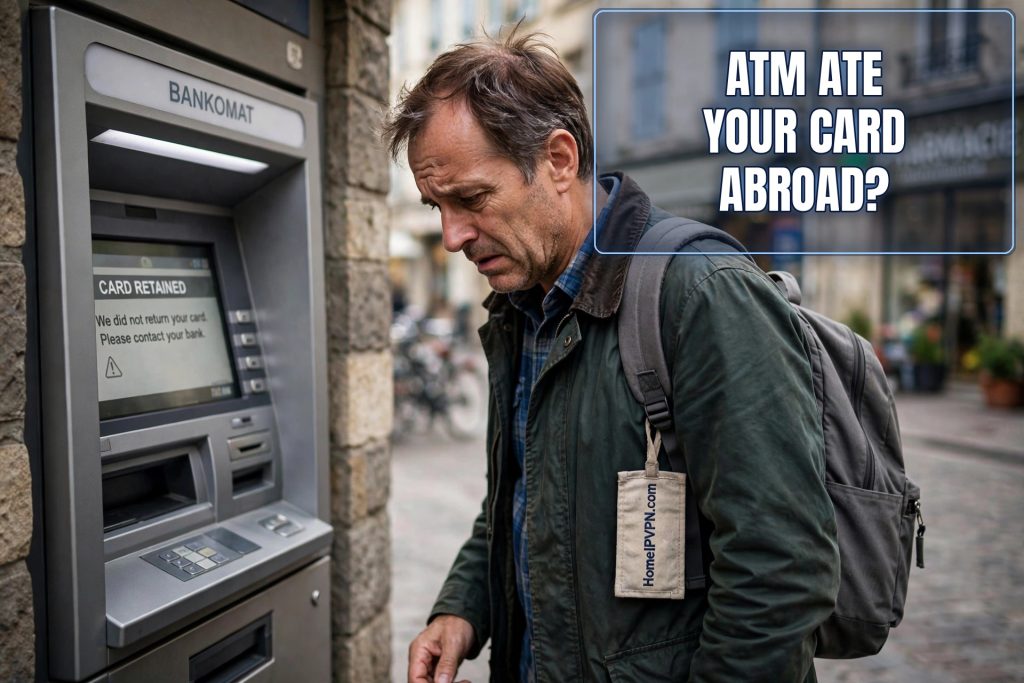
There are few travel moments as uniquely awful as standing in front of a foreign ATM, watching the screen go blank, and realizing your card is not coming back out. No cash. No card. Just you, a humming machine, and a growing sense of panic.
It feels like the machine malfunctioned. Most of the time, it did exactly what it was told. Here is what happened and what to do about it.
Why ATMs eat cards
An ATM is not a dumb cash box. Every withdrawal is a live conversation between the machine and your bank. You enter your PIN, the ATM asks your bank “is this okay?”, and your bank answers in seconds.
If your bank’s fraud system does not like what it sees, for example a withdrawal in a country with no travel notice on file, or your third withdrawal in an hour, or an amount that does not match your habits, it can instruct the ATM to retain the card. The machine is following orders. From the bank’s view, keeping the card is safer than handing cash to someone who might not be you.
Other triggers have nothing to do with fraud: entering the wrong PIN three times, leaving the card in the slot too long after the transaction, or the machine itself running low on cash or losing its connection mid-withdrawal. But for travelers, the fraud flag is the big one, and it is almost always a travel notice problem.
The travel notice mistake behind it
Nine times out of ten, the traveler in this story either never set a travel notice, set one that did not include this country (layover coffee counts as a transaction in a new country), or set one that quietly expired weeks ago on a long trip.
Here is the cruel detail: ATMs are stricter than card readers. A restaurant card terminal might approve a flagged purchase after you confirm a text message. An ATM cannot have that conversation with you. When the bank says no mid-withdrawal, retention is the default safe action. That is why the same trip can have perfectly fine restaurant payments and one very bad ATM visit.
What to do in the first 10 minutes
Do not panic and do not walk away yet.
- Document the machine. Take a photo of the ATM showing the bank name, the street address or branch, and the machine number (usually on a sticker on the side or top). You will need all of this when you call.
- Wait a full two minutes. Some machines are just slow, especially on bad connections. Give it a real chance before you conclude the card is gone.
- Call your bank. Use the international collect number on the back of your other card (you have a backup card, right? more on that below). Tell them the ATM retained your card, give them the machine details, and ask them to confirm no withdrawal was actually processed. Sometimes the cash never dispensed even though the card was kept, and you want that on record immediately.
- Ask about your options. The bank can rush a replacement card, often to a foreign address or a hotel, though it takes days and sometimes a fee. Ask specifically.
What not to do
Do not try to pry the machine open or shake it. Apart from looking extremely suspicious on a foreign street, you will not succeed; the retention mechanism is internal and locked. Do not leave without the machine’s details, because “an ATM somewhere in Bangkok” is not enough for your bank to trace it. And do not immediately try the same withdrawal on your backup card at the same machine. If the bank flagged the first attempt, the second one from the same flagged location can get your backup card eaten too.
The pre-trip checklist that prevents this
Card retention is one of the most preventable travel money disasters. Before every trip:
- Set a travel notice for every country, including layovers, with a few buffer days on each end.
- Carry two cards from two different banks. If one gets eaten or frozen, you are not stranded. Keep them in different places (one in your wallet, one in your bag).
- Raise your daily ATM limit before you leave, so you can take out larger amounts less often. Fewer withdrawals means fewer chances to trip the system.
- Save your bank’s international number in your phone contacts, not just on the back of the card you might lose.
- Tell your bank how long you will be gone. If it is months, ask what they recommend beyond a standard travel notice.
Will you get your money back?
The question everyone asks while staring at the retained-card screen: did I just lose that money? Usually, no. Here is how it works.
When the ATM keeps your card, there are two separate things that may or may not have happened: the card was retained, and cash may or may not have been dispensed. If the screen went blank before any cash came out, the withdrawal almost certainly never completed. The bank’s system reconciles incomplete ATM transactions automatically, usually within a few business days. The money was never actually taken; it was reserved and then released.
But do not assume. Check your account as soon as you can and look for the withdrawal. If you see the debit but received no cash, call your bank and file a dispute for that specific transaction. Say the words “ATM retained my card and did not dispense cash” and give them the machine details from your photo. Banks have a formal process for this, and legitimate claims are routinely credited back. It can take a week or two, which is painful, but the money comes back.
One more scenario: the machine dispensed cash after you walked away. This is rare with modern machines (most retract uncollected cash after 30 seconds), but it happens. If your account shows a completed withdrawal you did not receive, dispute it the same way. The ATM’s own camera and cash counts usually settle it in your favor.
How long does a replacement card take abroad?
When you call, ask specifically about emergency card replacement to a foreign address. Most major banks can do it. The honest answer on timing: three to seven business days for most destinations, sometimes faster in major cities, sometimes slower in remote areas. There is often a fee, typically in the $15 to $30 range, though some premium accounts waive it.
Have the card sent somewhere reliable: your hotel (confirm with the front desk that they accept guest mail), a coworking space with a real address, or a trusted friend’s place if you have one nearby. A hostel dormitory mail pile is not ideal for a bank card.
While you wait, bridge the gap. Most banks can push your replacement card into your phone’s digital wallet (Apple Pay or Google Pay) before the physical card arrives, sometimes within hours. That single trick has saved countless trips. If your bank offers it, say yes immediately. A surprising number of travelers do not know this exists until someone tells them.
The two-card system seasoned travelers swear by
Ask any long-term nomad how they carry money and you will hear some version of the same system: two cards, two banks, two places.
Two different banks matters because a fraud freeze is per bank. If one bank locks you out, the other one does not care. Two different card networks (one Visa, one Mastercard) matters because some countries and some merchants favor one over the other, and network outages happen. Two different physical places, one card in your wallet and one buried in your bag, matters because wallets get lost and stolen.
Take it one step further: keep a modest balance on the second account at all times, enough to live on for a week. A backup card with no money behind it is just a piece of plastic. Travelers who run this system treat card disasters as annoyances instead of emergencies, because they always have a working alternative while the bank sorts things out.
And the unglamorous final piece: photograph the front and back of every card you travel with and store the photos somewhere secure but reachable, like an encrypted note or a password manager. If every card you own disappears at once, those photos give you every number you need to start the recovery calls.
One more layer of protection
Most card-eating incidents start as a fraud flag, and most fraud flags start with your connection looking foreign. When your banking app and your bank’s website see your trusted home internet address instead of a random hotel network, the whole chain of suspicion often never starts.
HomeIPVPN gives you exactly that: your own home internet address on any device, anywhere you travel. It does not replace the checklist above, but it removes the single most common trigger behind these stories. Our Pre-Travel Audit & Advisory session gets it built and verified on your devices in 1 hour for $79, credited toward the full $279 Secure Home IP VPN System session setup.
And if you are reading this standing in front of a humming ATM: breathe, photograph the machine, and make the call. You will get through this.