REMOTE WORK & DIGITAL NOMAD
Working Remotely From Thailand: Internet, Banking, and Visas in Plain English
The first time I landed in Bangkok with a laptop and a one-way ticket, I made every mistake in the book. I tried to join a video call on hostel WiFi ten…
✓The Internet: Better Than You✓Bangkok vs. Chiang Mai: Picking✓Visas: The Part First-Timers Get
Quick Answer
Thailand is one of the easiest countries in the world to work from remotely: fast cheap internet, great coworking, and a visa built for remote workers. The main traps are banking logins from Thai networks, which can trigger fraud freezes, and overstaying the wrong visa type.
- Internet: Fast and cheap. Fiber in cities, solid 4G/5G everywhere, coworking spaces built for video calls.
- Visa: The Destination Thailand Visa (DTV) lets remote workers stay up to 180 days per entry. Tourist visas do not cover working.
- Banking: Keep your home accounts, but log in from Thai IPs carefully: sudden foreign logins are the top cause of frozen accounts.
- Stay connected safely: HomeIPVPN routes your work through your own home internet, so your bank and employer see your normal home connection, not a Thai cafe network.
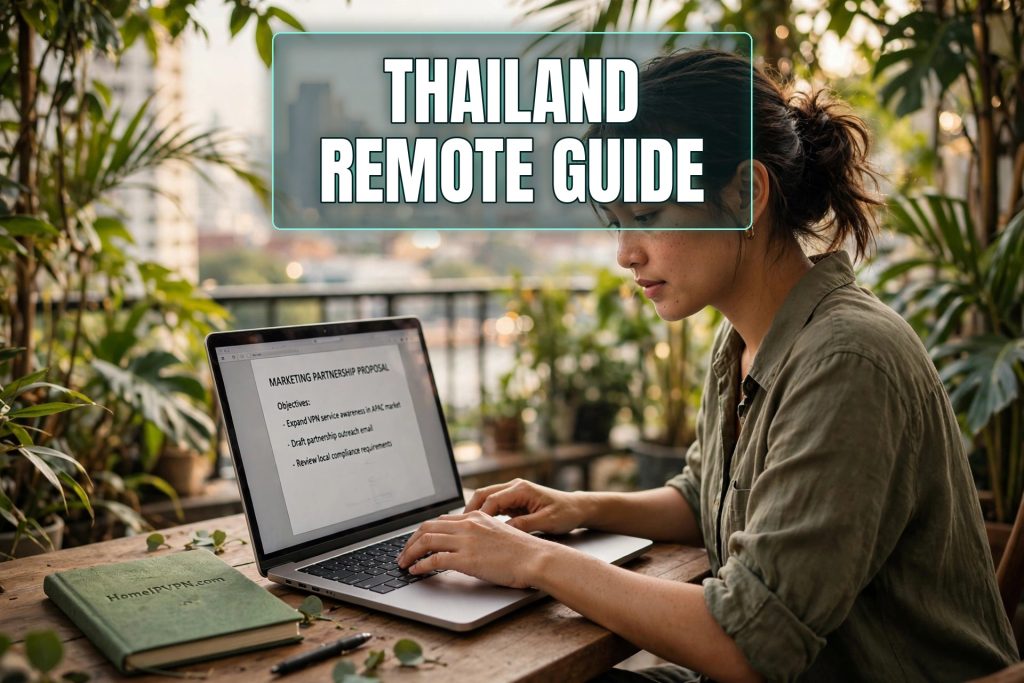
The first time I landed in Bangkok with a laptop and a one-way ticket, I made every mistake in the book. I tried to join a video call on hostel WiFi ten minutes after landing. I logged into my bank from the airport lounge and got locked out before I reached the taxi line. I assumed my tourist visa covered “working on my laptop,” which, strictly speaking, it does not.
Thailand forgives a lot of beginner mistakes. It is genuinely one of the most remote-work-friendly countries on earth, and that is not travel-blog hype. But the things that bite first-timers are specific and predictable: the internet is great until it is not, the banking works until your bank panics, and the visa situation is easy until you pick the wrong one. Let us walk through all of it in plain English.
The Internet: Better Than You Expect, With One Catch
Thailand’s internet is legitimately excellent by global standards, and cheap. In Bangkok and Chiang Mai, fiber connections in apartments and coworking spaces routinely run fast enough for anything you need: video calls, big uploads, screen sharing, all fine. A coworking day pass costs a few dollars. A monthly apartment with fiber included is normal, not a luxury.
Mobile data is the real superpower. Thai SIM cards are cheap, tourist SIMs are sold at the airport, and 4G coverage blankets the cities and most tourist areas. 5G is rolling out in Bangkok and the bigger cities. Most working nomads end up with a simple setup: apartment WiFi for heavy work, phone hotspot as the backup, and a local SIM that costs less than a week of coffee back home.
The catch is the islands and the beach towns. That bungalow on a Thai island with the hammock on the porch? Its WiFi might be a single router shared with twenty guests, fed by a connection that struggles at sunset when everyone is on a call. If your work depends on video meetings, do not book the dream beach hut for your first month. Base yourself in Bangkok or Chiang Mai, test your actual work routine, and take the island trips once you know your backup plans work. The number one complaint from first-timers is not the speed in Thailand. It is booking accommodation for the view and discovering the WiFi at 8 p.m.
Bangkok vs. Chiang Mai: Picking Your Base
Almost every remote worker in Thailand ends up choosing between these two cities first, and they are genuinely different work experiences.
Bangkok is the infrastructure king. Fastest internet, most coworking spaces, best mobile coverage, biggest expat and nomad community. It is a real working city where your professional life just functions. The tradeoff is that it is a massive, hot, chaotic metropolis. Your commute to a coworking space might be a sweaty train ride. Apartments are pricier than up north, though still cheap by Western standards.
Chiang Mai is the lifestyle pick. Slower pace, mountain air, a legendary nomad community, and costs so low they feel like a typo. The internet is perfectly good for remote work, and the famous coworking spaces were basically built for people like you. The tradeoff is burning season, roughly February to April, when agricultural smoke makes the air genuinely unpleasant, and a smaller, sleepier city that some people outgrow.
Honest advice: start in Bangkok for a month. Get your systems working, your SIM sorted, your banking stable. Then go to Chiang Mai and see if the slower rhythm suits your work style. Most people who skip the Bangkok shakedown month end up troubleshooting basics from a mountain town instead of enjoying it.
Visas: The Part First-Timers Get Wrong
Here is the plain-English version. A tourist visa or visa exemption lets you be a tourist. It does not technically cover working, even on your laptop for a foreign employer. In practice, Thailand has not historically chased laptop workers in cafes, but “nobody bothered me” is not a legal strategy, and the rules have been tightening.
The Destination Thailand Visa, the DTV, is the one built for you. It is designed for remote workers and allows stays of up to 180 days per entry, with the possibility to extend. You apply showing you work remotely and can support yourself, and the requirements are published and straightforward. If you plan to base yourself in Thailand for months rather than weeks, the DTV is the grown-up choice. It removes the background anxiety of doing border runs every month and wondering if this is the time an officer asks questions.
What not to do: do not overstay, ever. Thai overstay fines and black marks are real and they follow you. Do not work for a Thai company or Thai clients on a tourist status. And do not assume the rules you read on a blog from 2022 still apply. Visa rules change, so check the current requirements on the official Thai embassy site for your country before you fly. This post is a starting map, not legal advice.
Banking: The Trap Nobody Warns You About
This is the section that will save someone a very bad week. Your home bank account works fine from Thailand, right up until your bank’s fraud system notices you.
Here is what happens. You land, you connect to the airport WiFi, you open your banking app to check that your rent payment went through. Your bank sees a login from a Thai IP address, on a shared airport network, twelve time zones from your last login, on a device connecting from a network it has never seen. To the fraud algorithm, you look exactly like a stolen account. Some banks freeze first and ask questions later, and “later” means a phone call to a fraud department that is closed for the night in your home time zone.
First-timers can dodge most of this with preparation. Before you fly, tell your bank you are traveling, set up every alert they offer, and make sure your two-factor authentication does not depend on a phone number you are about to lose. Save your bank’s international collect-call number somewhere you can reach it without logging in. And when you land, do your first banking login from your phone’s mobile data, not the airport WiFi: a cellular connection is both safer and less suspicious than a shared airport network.
For long stays, the deeper fix is to stop looking like a traveler at all. When your internet connection goes through HomeIPVPN, your bank sees your familiar home IP address and your normal residential connection, the same one it has seen for years. There is no Thai IP, no airport network, no fraud flag. You can check your balance from a beach in Phuket and look, to your bank, exactly like you never left the couch. For people living abroad for months, that quiet normality is worth more than any travel hack.
Money on the Ground: Cash, Cards, and Getting Paid
Thailand runs on a mix. Cards work in malls, coworking spaces, and nicer restaurants. Street food, markets, taxis, and small shops are cash territory. ATMs are everywhere but charge a foreign-card fee per withdrawal, usually around 220 baht, so withdraw larger amounts less often rather than small amounts daily.
Tell your bank about Thailand before you go, and bring at least two different cards from different banks. If one gets frozen or eaten by an ATM, and ATMs do occasionally eat cards, you are not stranded. Keep the backup card in your accommodation, not in the same wallet as the first one. This sounds paranoid until the day it saves your trip.
Getting paid while in Thailand is the same as getting paid anywhere as a remote worker: your employer’s payroll does not care where you sit. Freelancers should sort out their invoicing and payment platforms before leaving, because verifying a new payment account from a Thai IP address can trigger the same fraud flags as banking. Set it all up at home, test it, then fly.
The Daily Rhythm That Actually Works
A quick word on the lifestyle side, because Thailand’s time zone shapes your workday more than most first-timers expect. Thailand is 11 to 14 hours ahead of the US, depending on daylight saving. If you work with a US team, your afternoons and evenings are meeting time, and your mornings are gloriously free. Many nomads in Thailand do their deep work in the quiet morning, take the middle of the day for life, and do calls in the evening.
With Europe, the gap is kinder: 5 to 7 hours. Your workday overlaps almost fully with a European afternoon. This is one reason Thailand works so well for Europeans and Australians, and why Americans in Thailand tend to become night owls.
Build your routine around the overlap, not against it. The nomads who burn out in Thailand are the ones who try to keep home-country hours, sleeping through the beautiful mornings and working until 3 a.m. Flip it. Let Thailand’s mornings be yours.
What First-Timers Actually Get Wrong: The Short List
Booking the island bungalow first, before testing their work setup in a city. Logging into the bank from airport WiFi on day one. Assuming the tourist stamp covers remote work for six months. Bringing one bank card. Trying to keep US hours instead of flipping the day. Skipping the local SIM and paying roaming fees that cost more than the flight.
Every one of these is fixable in advance, and every one of them is obvious in hindsight. That is the whole game with working from Thailand: the country makes the easy parts very easy, so the mistakes cluster in the few places nobody warned you about. Now you have been warned.
Thailand rewards preparation and punishes assumptions, like most good things. Get the visa right, get your banking stable before you fly, base yourself where the internet is boring and reliable, and the country takes care of the rest: the food, the cost of living, the community of people doing exactly what you are doing.
And about that banking piece: the travelers who have the smoothest time are the ones whose banks never notice they left. If you want your connection, your logins, and your whole online life to look like home while you are living in Thailand, that is precisely what HomeIPVPN does. If you would rather have someone set it up for you and verify it works before your flight, the Pre-Travel Audit & Advisory session is 1 hour, costs $79, and that fee comes straight off the $279 Secure Home IP VPN System session if you go ahead.
Land prepared, work well, and save me a seat at the night market. You are going to love it here.