TROUBLESHOOTING
Bank Account Closed While Living Abroad: The Story Nobody Warns Expats About
The email arrives on a Tuesday morning while you are making coffee in your apartment in Mexico City. The subject line is bland, the kind you almost delete:…
✓Why a bank would close a perfectly✓Decoding the closure letter✓The timeline: what actually
Quick Answer
Banks close accounts of overseas customers mostly for compliance reasons: residency rules, anti money laundering monitoring, and the cost of serving customers they cannot easily verify. You usually get a written notice with a deadline before it happens. Keep a valid home-country address on file, keep the account active, and keep your phone number reachable, and most accounts stay open indefinitely.
- Why it happens: Banks must verify where customers live. A customer they cannot verify, in a country they cannot easily monitor, becomes a compliance risk.
- The warning: You almost always get a letter or secure message first, usually giving you 30 to 60 days. The danger is missing it because it went to an old address.
- Keep it alive: Maintain a home-country mailing address, log in regularly from a consistent connection, and keep small recurring activity on the account.
- Reduce the risk: Accounts that always appear from the same trusted home connection look like ordinary domestic accounts to monitoring systems, which is exactly the setup HomeIPVPN provides for people living abroad.
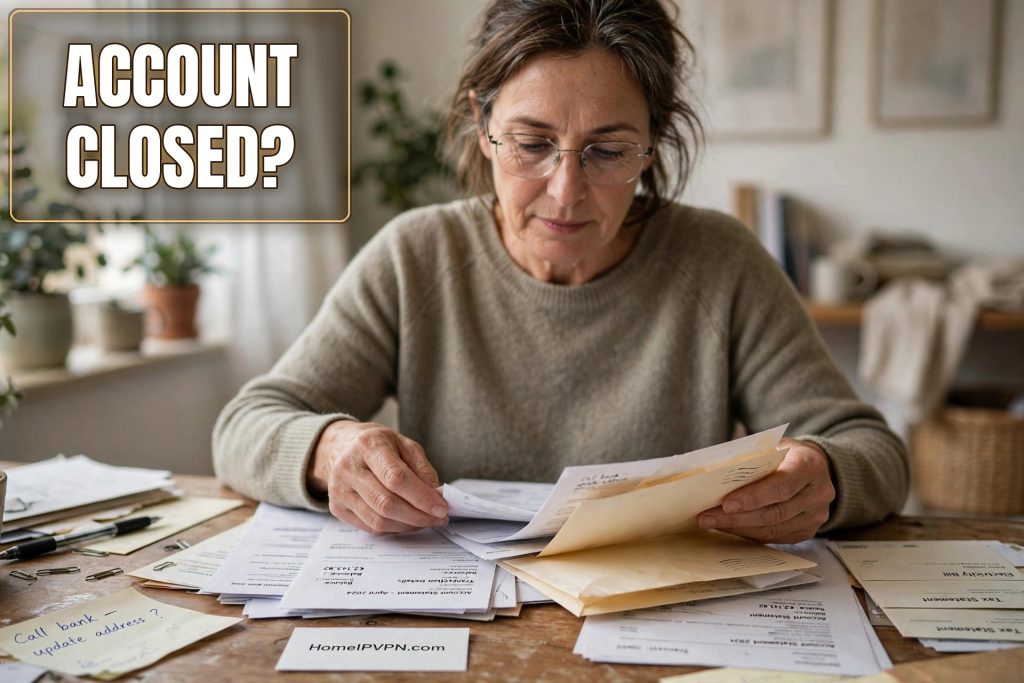
The email arrives on a Tuesday morning while you are making coffee in your apartment in Mexico City. The subject line is bland, the kind you almost delete: “Important information about your account.” Inside, in the bank’s calm corporate font, is a sentence that rearranges your whole life: “We have decided to close your account. Your remaining balance will be mailed to you by check within 30 days.”
You read it three times. You have had this account for eleven years. Your paychecks land there. Your rent back home comes out of it. You call the number in the email and the representative is polite and completely unhelpful: “This was a business decision. We cannot provide further details.”
This is the story nobody warns expats about, and it happens far more often than banks admit. Here is why accounts get closed on people living abroad, what the letter actually means, and how to keep yours alive from another country.
Why a bank would close a perfectly good account
It feels personal. It is not. Account closures of overseas customers are almost always driven by three cold business reasons, and understanding them is the key to avoiding the same fate.
Reason one: compliance costs money. Banks are legally required to know their customers. That phrase, “know your customer,” is actual banking law in most countries, and it means the bank must be able to verify who you are, where you live, and that your money comes from legitimate sources. Verifying a customer in Ohio is cheap and routine. Verifying a customer who lives in Vietnam, earns in euros, and receives transfers from three countries is expensive and complicated. At some point, for some banks, the math stops working, and the account gets closed. Not because you did anything wrong, but because you became expensive to keep.
Reason two: foreign activity is harder to monitor. Banks must watch for money laundering, which is just a formal term for criminals disguising illegal money as legal money. The monitoring systems are tuned for domestic patterns. A customer whose logins, transfers, and spending all happen overseas generates constant low-level alerts that someone has to review. Multiply that by thousands of expat customers and the bank has a staffing problem. Closing the accounts is cheaper than monitoring them.
Reason three: residency rules. Many banks write into their account agreements that you must be a resident of the home country. When their records show you have been logging in from abroad for two years, receiving mail at a foreign address, or told a representative you moved overseas, the account can be flagged as violating its own terms. The bank is not accusing you of fraud. It is enforcing a clause you signed years ago without reading.
None of these reasons involve you being a bad customer. Plenty of closed accounts belonged to people with perfect payment histories and healthy balances. The bank simply decided that overseas customers, as a category, were more trouble than they were worth.
Decoding the closure letter
The letter is designed to tell you almost nothing, but it actually contains useful information if you know how to read it.
“We have decided to close your account.” This is a voluntary closure by the bank, which is legally different from a freeze. A freeze means they suspect something and your money is stuck. A closure means they are ending the relationship and must return your money. That distinction matters: in a closure, they owe you your balance.
“This was a business decision.” Translation: compliance or profitability, not fraud. If they suspected fraud or money laundering, they would not be mailing you a check; they would be filing reports and possibly freezing funds. “Business decision” is the bank’s way of saying the account is not worth the trouble. It also means there is usually no appeal process, because there is no accusation to appeal.
“We cannot provide further details.” This is the line that drives people crazy, but it is standard. Banks are advised by their lawyers not to explain closure decisions, partly because explanations can be used against them and partly because the real reason (“your file got flagged by an automated residency review”) sounds absurd when said out loud.
The deadline and the check. The letter should tell you when the account closes and how you will receive your money, usually a cashier’s check mailed to your address on file. Read this part twice. If the address on file is an old apartment you left three years ago, your money is about to be mailed to a stranger’s mailbox. Updating your mailing address is the single most urgent thing to do the day you get this letter.
The timeline: what actually happens next
Knowing the sequence takes away most of the panic.
Days 1 to 7: the notice period starts. You typically get 30 to 60 days before the closure takes effect. During this window the account still works normally. Do not wait. Start moving your financial life immediately: redirect direct deposits, move automatic bill payments, and identify where the final check should go.
Weeks 2 to 4: wind down recurring activity. List everything connected to the account: paycheck deposits, subscription charges, rent payments, the card saved in every shopping app. Move them one by one to another account. People always forget at least one, usually a small annual subscription, and discover it months later when a payment bounces.
The closing date: the balance becomes a check. On the closing date, the bank zeroes the account and mails you the remaining balance as a cashier’s check. This is where expats get hurt most: the check goes to the address on file, it can take weeks to arrive internationally, and cashing a home-country check from abroad can be its own adventure. If possible, wire the bulk of the balance to another account yourself before the closing date, leaving just enough to keep the account technically open until the end.
After closure: the record. A bank-initiated closure is not the same as a bad mark on your credit. It does not go on your credit report as a negative item. But the bank keeps an internal record, and some banks share closure information with each other through industry databases. Opening a new account at the same bank later can be difficult. At a different bank, you start fresh.
Why expats get targeted (and who is safest)
Not every overseas customer gets closed. The pattern is fairly predictable once you see it.
Highest risk are customers with no home-country address on file, accounts that have gone dormant (no logins, no transactions for many months), customers in countries under sanctions or on high-risk lists, and accounts with large international wire transfers that nobody can easily explain. If you match two or more of these, you are in the danger zone.
Lowest risk are customers who kept a valid home address on file, log in regularly, keep steady domestic-looking activity like a subscription or a small recurring transfer, and maintain a reachable phone number. From the bank’s monitoring perspective, these accounts look almost identical to domestic accounts. The system has no reason to look twice.
Notice what separates the two groups. It is not citizenship, income, or how long you have been abroad. It is whether the account still looks like it belongs to someone the bank can find, verify, and understand. Everything in the next section is about staying in that second group.
How to keep your account alive from another country
This is the practical part. None of this requires a lawyer. It requires being deliberate about the signals your account sends.
Keep a valid home-country address on file. This is the single most important thing. Most banks require a domestic address, and “we cannot reach you” is the fastest path to closure. Options that work: a family member’s address (with their permission), a trusted friend’s address, or a mail forwarding service that gives you a real street address rather than a PO box. Update it with the bank officially, through the app or a secure message, not just in your head. Whatever you do, do not let the bank’s records show a foreign address as your primary residence unless you have confirmed that specific bank allows it. A HomeIPVPN connection helps here too in an indirect way: when you handle address updates and secure messages while appearing from your home connection, nothing in the session contradicts the domestic address on file.
Keep the account visibly active. Dormant accounts get reviewed, and reviewed accounts get closed. You do not need big transactions. A small monthly pattern is enough: a subscription charge, a transfer between your own accounts, a bill payment. Set two or three tiny recurring items and let them run. Activity says “this is a living account with an engaged owner.” Silence says “nobody is home, close it.”
Log in regularly from a consistent connection. Sporadic logins from a rotating cast of foreign networks paint exactly the picture compliance teams dislike: an account drifting around the world with no anchor. A regular login rhythm from one consistent, familiar connection tells the opposite story. This is one of the quietest and most effective things an expat can do, and it is the reason many long-term travelers route their banking through their own home internet connection even years into living abroad.
Keep your phone number reachable. Banks verify identity through the phone number on file. If yours is disconnected, you become unverifiable, and unverifiable customers are exactly who compliance teams cut. Keep the home number alive on the cheapest plan available, or port it to a service that receives texts over the internet. Test it twice a year by having the bank send a code.
Keep a balance that justifies the account. You do not need to be rich, but an account holding a few hundred dollars with regular activity looks like a real banking relationship. An account with eleven dollars and no logins for eight months looks abandoned. Banks close abandoned things.
File the paperwork your situation requires. If you are a US citizen abroad, you still file US taxes, and foreign bank accounts over certain thresholds get reported on FBAR forms. This is about your foreign accounts, not your home account, but having your tax paperwork clean removes one more reason for anyone to look twice. If your bank ever sends a tax form or a request to confirm your details, answer it the same week. Ignored compliance mail is a classic trigger for the review that ends in closure.
Do not volunteer your move. This sounds cynical, but it is practical: if a bank representative asks where you live, answer truthfully, but do not call the bank to announce you have moved abroad unless you need to. Many closure stories start with a well-meaning customer updating their address to a foreign one “to be honest,” and the honest update triggering the residency review that closes the account. Keep a valid domestic address on file and let the account speak for itself.
If the letter already arrived: your action plan
First, breathe. Then work this list in order. Update your mailing address immediately so the final check reaches you. Open a replacement account somewhere else before the closing date, ideally at a bank known to be friendlier to overseas customers, and start moving direct deposits and autopays. Wire most of the balance out yourself rather than waiting for a mailed check. Download at least a year of statements, because once the account closes, getting old records becomes a bureaucratic quest. And if any deposit is scheduled to land after the closing date, reroute it now; money sent to a closed account bounces back to the sender, which can take weeks to untangle.
One more thing: ask the representative, politely, whether the closure affects any linked accounts, credit cards, or safe deposit boxes. Closures sometimes cascade to products you forgot were connected. Get the answer in writing through secure message if you can.
Opening a new account from abroad (when it is too late)
It is harder than it used to be, but it is doable. Online banks and fintech companies are generally more comfortable with non-resident customers than traditional branch banks, because their whole verification process was built for people they never meet in person. You will still need a valid ID, a tax identification number, and usually a domestic address. Some banks allow video verification calls, which solved the “appear in person” problem that used to make this impossible.
Whatever you open, set it up right from day one: domestic address on file, reachable phone number, regular activity, consistent login connection. The habits that would have saved the old account are the same habits that protect the new one. Think of it as a fresh start with better armor.
The root cause of most expat account closures is painfully simple: the bank could no longer verify, reach, or understand the customer, so the customer became a compliance risk instead of a customer. Staying reachable, active, and verifiable is the problem HomeIPVPN was built to solve. If you would rather have someone set it up and verify it works, the Pre-Travel Audit & Advisory session is 1 hour, costs $79, and that fee comes straight off the $279 Secure Home IP VPN System session if you go ahead.
Eleven years of banking history should not end with a form letter and a mailed check. A few deliberate habits keep your account boring, reachable, and open, which is exactly how you want a bank to see you. Here is to many more years with the same account number.